
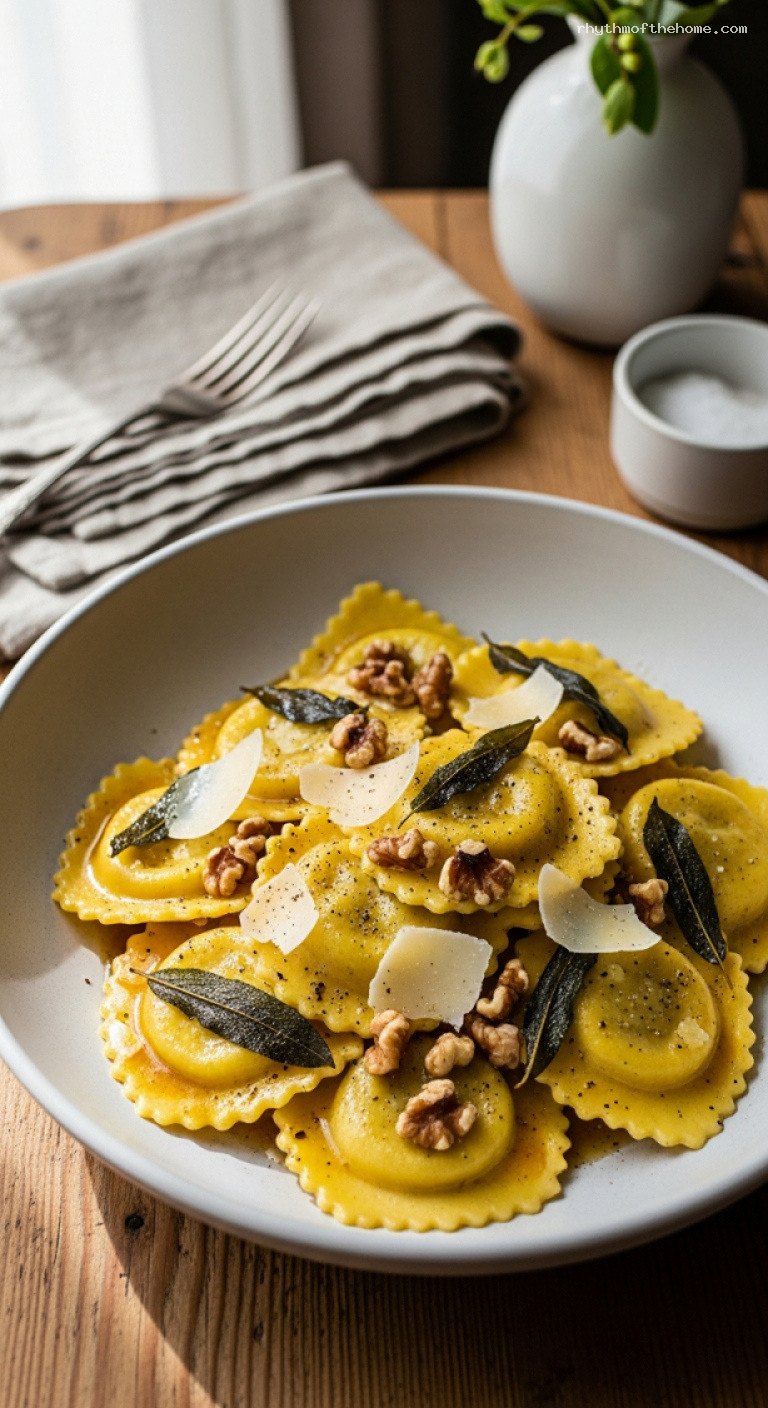
Quick Recipe Version (TL;DR)
Quick Ingredients
- Pasta dough: 2 cups (250 g) all-purpose or 00 flour, 3 large eggs, 1 tbsp olive oil, 1/2 tsp fine salt
- Squash: 1 small butternut squash (about 2 lb / 900 g), 2 tbsp olive oil, 1/2 tsp salt, black pepper
- Filling: roasted squash, 1/2 cup (55 g) finely grated Parmesan, 1/2 cup (120 g) whole-milk ricotta (well drained), 1 egg yolk, 1/4 tsp ground nutmeg, salt and pepper
- Sauce: 8 tbsp (113 g) unsalted butter, 12–16 fresh sage leaves, 1/2 cup (50 g) walnut halves (toasted and chopped), 1 tbsp fresh lemon juice, salt and pepper
- To serve: extra finely grated or shaved Parmesan, more black pepper
Do This
- 1. Make pasta dough by mixing flour, eggs, olive oil, and salt; knead 8–10 minutes until smooth, then wrap and rest 30 minutes.
- 2. Roast cubed butternut squash at 400°F (200°C) with olive oil, salt, and pepper for 30–35 minutes until very soft and caramelized.
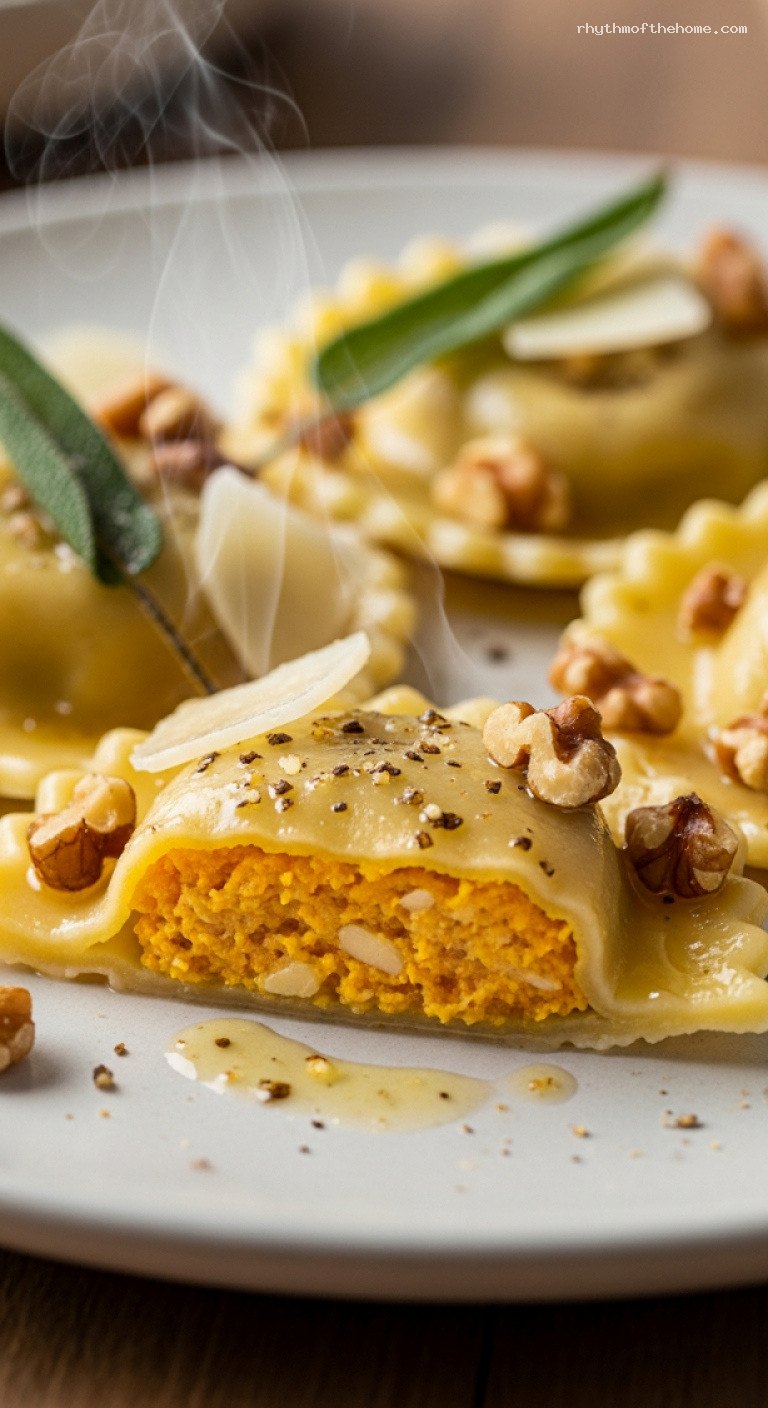
- 3. Mash squash and mix with Parmesan, ricotta, egg yolk, nutmeg, salt, and pepper into a thick, scoopable filling.
- 4. Roll dough into thin sheets (setting 6–7 on a pasta machine or about 1 mm thick) and portion small mounds of filling; cover with a second sheet and seal well, then cut ravioli.
- 5. Toast walnuts in a dry pan 4–5 minutes until fragrant; set aside. Boil salted water.
- 6. Simmer ravioli 2–3 minutes in gently boiling salted water until they float and pasta is tender.
- 7. Brown butter with sage until golden and nutty; add lemon juice. Toss ravioli gently in sauce, top with walnuts and Parmesan, and serve immediately.
Why You’ll Love This Recipe
- Silky homemade pasta wrapped around a cozy roasted butternut squash and Parmesan filling.
- A deeply flavorful brown butter and sage sauce that feels restaurant-level but is simple to make.
- Toasted walnuts add crunch and a nutty aroma that balances the sweetness of the squash.
- Great for a special dinner, yet approachable for home cooks with clear step-by-step guidance.
Grocery List
- Produce: 1 small butternut squash, fresh sage, 1 lemon, optional fresh parsley (for garnish)
- Dairy: Eggs, unsalted butter, whole-milk ricotta, Parmesan cheese
- Pantry: All-purpose or 00 flour, olive oil, walnut halves, fine salt, black pepper, ground nutmeg
Full Ingredients
For the Pasta Dough
- 2 cups (250 g) all-purpose flour or 00 flour, plus extra for dusting
- 3 large eggs (room temperature)
- 1 tbsp extra-virgin olive oil
- 1/2 tsp fine sea salt
- 1–2 tbsp water, only if needed to bring the dough together
For the Roasted Squash
- 1 small butternut squash (about 2 lb / 900 g), peeled, seeded, and cut into 1/2-inch (1.25 cm) cubes
- 2 tbsp extra-virgin olive oil
- 1/2 tsp fine sea salt
- 1/4 tsp freshly ground black pepper
For the Ravioli Filling
- All of the roasted butternut squash, cooled slightly
- 1/2 cup (55 g) finely grated Parmesan cheese (Parmigiano Reggiano recommended)
- 1/2 cup (120 g) whole-milk ricotta cheese, well drained
- 1 large egg yolk
- 1/4 tsp ground nutmeg
- Fine sea salt and freshly ground black pepper, to taste
For the Brown Butter Sage Sauce & Walnuts
- 8 tbsp (113 g) unsalted butter
- 12–16 fresh sage leaves
- 1/2 cup (50 g) walnut halves, toasted and roughly chopped
- 1 tbsp freshly squeezed lemon juice
- Fine sea salt and freshly ground black pepper, to taste
For Serving
- 1/4–1/3 cup extra finely grated or shaved Parmesan
- Freshly ground black pepper
- Optional: finely chopped fresh parsley for color
Step-by-Step Instructions
Step 1: Make and Rest the Pasta Dough
Place the flour in a mound on a clean work surface or in a large mixing bowl. Make a wide well in the center. Add the eggs, olive oil, and salt to the well. Using a fork, whisk the eggs and oil together, gradually pulling in flour from the edges until a thick paste forms. Continue incorporating flour until a shaggy dough develops, then switch to your hands and knead.
Knead the dough for 8–10 minutes, dusting lightly with flour only if very sticky, until it becomes smooth, elastic, and slightly tacky but not wet. If the dough is very dry and crumbly, sprinkle in 1–2 teaspoons of water at a time and knead until it comes together. Form into a ball, wrap tightly in plastic wrap (or cover with an inverted bowl), and let rest at room temperature for at least 30 minutes. This relaxes the gluten so the dough rolls out thinly without springing back.
Step 2: Roast the Butternut Squash
While the dough rests, preheat the oven to 400°F (200°C). Line a baking sheet with parchment paper for easier cleanup. Spread the cubed butternut squash on the sheet, drizzle with the olive oil, and sprinkle with the salt and pepper. Toss well to coat and spread into an even layer so the pieces are not crowded.
Roast for 30–35 minutes, stirring once halfway through, until the squash is very tender and lightly caramelized at the edges. You should be able to easily mash it with a fork. Remove from the oven and let cool for 5–10 minutes before making the filling so it does not melt the cheese or scramble the egg yolk.
Step 3: Mix the Creamy Squash Filling
Transfer the warm (not piping hot) roasted squash to a large bowl. Mash thoroughly with a fork or potato masher until very smooth, or pulse in a food processor for an ultra-silky texture. Add the grated Parmesan, drained ricotta, egg yolk, and ground nutmeg. Stir until everything is completely combined and creamy.
Taste the filling and season with additional salt and pepper as needed. The filling should be well seasoned because the pasta itself is quite mild. The texture should be thick and scoopable, not runny. If it feels too loose, stir in an extra tablespoon or two of grated Parmesan to firm it up. Cover and refrigerate while you roll the dough; a slightly cool filling is easier to handle.
Step 4: Roll Out the Pasta Sheets
Cut the rested dough into 2–4 equal pieces, keeping the pieces you are not working with wrapped so they do not dry out. Lightly flour your work surface and the dough. Flatten one piece into a rough rectangle with your hands. If using a pasta machine, start on the widest setting and pass the dough through. Fold it into thirds like a letter, rotate 90 degrees, and run it through again. Repeat this folding and rolling 3–4 times to build strength and smoothness, dusting lightly with flour if needed.
Then gradually reduce the machine setting, passing the dough through once per setting without folding, until it is very thin (usually setting 6 or 7 on most machines, about 1 mm thick). If rolling by hand, use a rolling pin and plenty of elbow grease to roll the dough into a thin, almost translucent sheet. Lay the sheet on a lightly floured surface or a floured kitchen towel. Aim for a long rectangle about 4–5 inches (10–12 cm) wide. Repeat with remaining dough pieces. Keep rolled sheets lightly floured and covered with a towel so they do not dry out.
Step 5: Fill, Seal, and Cut the Ravioli
Working with one sheet at a time, place it on a lightly floured surface. Using a teaspoon or small scoop, drop small mounds of filling (about 2 teaspoons each) in two rows along half of the sheet, leaving about 1–1 1/2 inches (2.5–4 cm) between mounds. Lightly brush the dough around the filling with water; this helps seal the ravioli.
Fold the other half of the sheet over the mounds of filling, gently pressing around each mound with your fingers to push out air and seal the dough. Air pockets can cause ravioli to burst while cooking, so take a moment to press firmly. Use a ravioli cutter, pastry wheel, or knife to cut into individual pillows, trimming edges if needed. Press edges once more with your fingers or the tines of a fork to ensure a tight seal. Set finished ravioli in a single layer on a lightly floured baking sheet. Repeat with remaining dough and filling. Keep ravioli lightly covered with a towel while you work.
Step 6: Cook the Ravioli in Salted Water
Bring a large pot (at least 4 quarts / 3.8 L) of water to a boil. Add salt generously; a good guideline is about 2 tbsp kosher salt for a large pot, so the water tastes pleasantly salty like the sea. Reduce the boil to a gentle, steady simmer to avoid rough bubbling that can tear delicate pasta.
Working in batches to avoid crowding, carefully slide the ravioli into the water. Stir gently once so they do not stick to the bottom. Cook for 2–3 minutes, just until they float to the surface and the pasta is tender but still slightly firm to the bite. Use a slotted spoon to transfer the cooked ravioli to a warm serving dish or pan. Reserve about 1/2 cup of the pasta cooking water to adjust the sauce later if needed.
Step 7: Make the Brown Butter Sage Sauce and Serve
While the water is heating or the ravioli are cooking, toast the walnuts in a dry skillet over medium heat for 4–5 minutes, stirring often, until fragrant and lightly browned. Transfer to a cutting board, cool slightly, and roughly chop.
In a large skillet or wide saucepan, melt the butter over medium heat. Add the sage leaves. Cook, swirling the pan often, for 4–6 minutes until the butter foams, the milk solids at the bottom turn deep golden brown, and it smells nutty. Watch closely so it does not burn. Remove from the heat and immediately stir in the lemon juice and a pinch of salt and pepper.
Add the drained ravioli directly to the skillet with the brown butter (work in batches if your pan is small). Toss very gently to coat, adding a spoonful or two of reserved pasta water if the sauce seems too thick or if you want it a bit looser and silkier. Sprinkle in the chopped toasted walnuts. Plate the ravioli in warm shallow bowls, spooning extra brown butter, sage leaves, and walnuts over the top. Finish with plenty of grated or shaved Parmesan and freshly ground black pepper. Serve right away while everything is hot and glossy.
Pro Tips
- Drain the ricotta well. Excess moisture makes the filling runny and harder to seal in the ravioli. Let ricotta sit in a fine-mesh strainer or cheesecloth for 15–30 minutes if it looks wet.
- Keep the dough and ravioli from drying out. Work with smaller pieces of dough and cover rolled sheets and formed ravioli with a lightly damp (not wet) kitchen towel as you go.
- Push out air around the filling. Use your fingers to snug the dough right up against the filling. Less trapped air means fewer ravioli bursting in the water.
- Gently simmer, do not aggressively boil. A strong rolling boil can tear delicate pasta. Aim for a steady simmer with small bubbles.
- Watch the brown butter closely. It goes from nutty and golden to burnt quickly. As soon as the milk solids turn deep amber and smell toasty, pull it off the heat.
Variations
- Herby filling twist: Add 1–2 tablespoons of finely chopped fresh sage or thyme to the squash filling for extra herbal depth.
- Cheesier filling: Swap half of the Parmesan in the filling for Pecorino Romano for a sharper, saltier bite.
- Nut-free version: Omit walnuts entirely or replace them with toasted pumpkin seeds for crunch without tree nuts.
Storage & Make-Ahead
Uncooked ravioli freeze beautifully. Arrange them in a single layer on a floured or parchment-lined baking sheet and freeze until solid, about 1–2 hours. Transfer to a freezer bag or airtight container and store for up to 1 month. Cook from frozen in gently simmering salted water, adding 1–2 extra minutes to the cooking time. Leftover cooked ravioli can be refrigerated in an airtight container for up to 2 days; reheat gently in a skillet with a bit more butter or a splash of water. The roasted squash filling can be made up to 2 days ahead and kept covered in the refrigerator. The pasta dough can be wrapped tightly and refrigerated for up to 24 hours; let it sit at room temperature for 20–30 minutes before rolling so it softens slightly.
Nutrition (per serving)
Approximate values for 1 of 4 servings: about 800 calories; 38 g fat; 22 g saturated fat; 75 g carbohydrates; 7 g fiber; 8 g sugar; 32 g protein; 780 mg sodium. These numbers will vary based on exact pasta thickness, cheese amounts, and how much sauce and Parmesan you add at the table.

Leave a Reply