
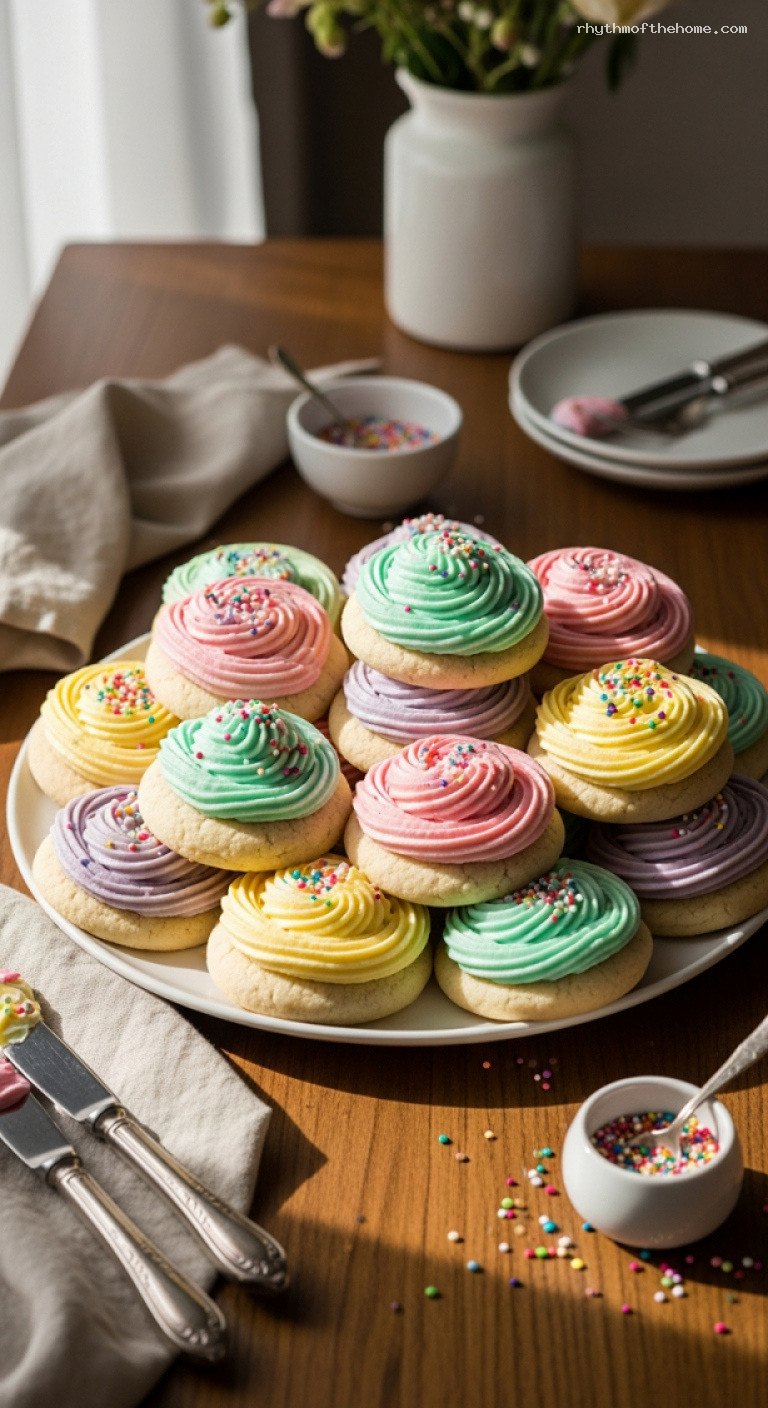
Quick Recipe Version (TL;DR)
Quick Ingredients
- 2 3/4 cups (330 g) all-purpose flour
- 1 1/2 tsp baking powder, 1/2 tsp fine salt
- 2 cups (452 g) unsalted butter, softened (divided)
- 1 1/4 cups (250 g) granulated sugar
- 1 large egg + 1 large egg yolk
- 4 1/2 tsp vanilla extract (divided), 1/4 tsp almond extract (optional)
- 2 tbsp sour cream
- 3 1/2 cups (420 g) powdered sugar, sifted
- 2–3 tbsp heavy cream or whole milk
- Gel food coloring, assorted sprinkles
Do This
- 1. Whisk flour, baking powder, and salt. Cream butter and sugar, then beat in egg, yolk, vanilla, almond extract, and sour cream.
- 2. Mix dry ingredients into wet just until a soft dough forms. Divide, flatten into discs, wrap, and chill 1 hour.
- 3. Preheat oven to 350°F (175°C). Roll dough to 1/4 inch between parchment, cut shapes, and place on lined baking sheets.
- 4. Bake 8–10 minutes until just set and pale. Cool on sheet 5 minutes, then transfer to a rack to cool completely.
- 5. Beat butter for frosting until creamy. Gradually mix in powdered sugar, vanilla, salt, and enough cream for a thick, spreadable consistency.
- 6. Tint portions of frosting with gel food coloring. Spread or pipe thick swirls onto cooled cookies.
- 7. Top immediately with sprinkles. Let frosting set 30–60 minutes before stacking or storing.
Why You’ll Love This Recipe
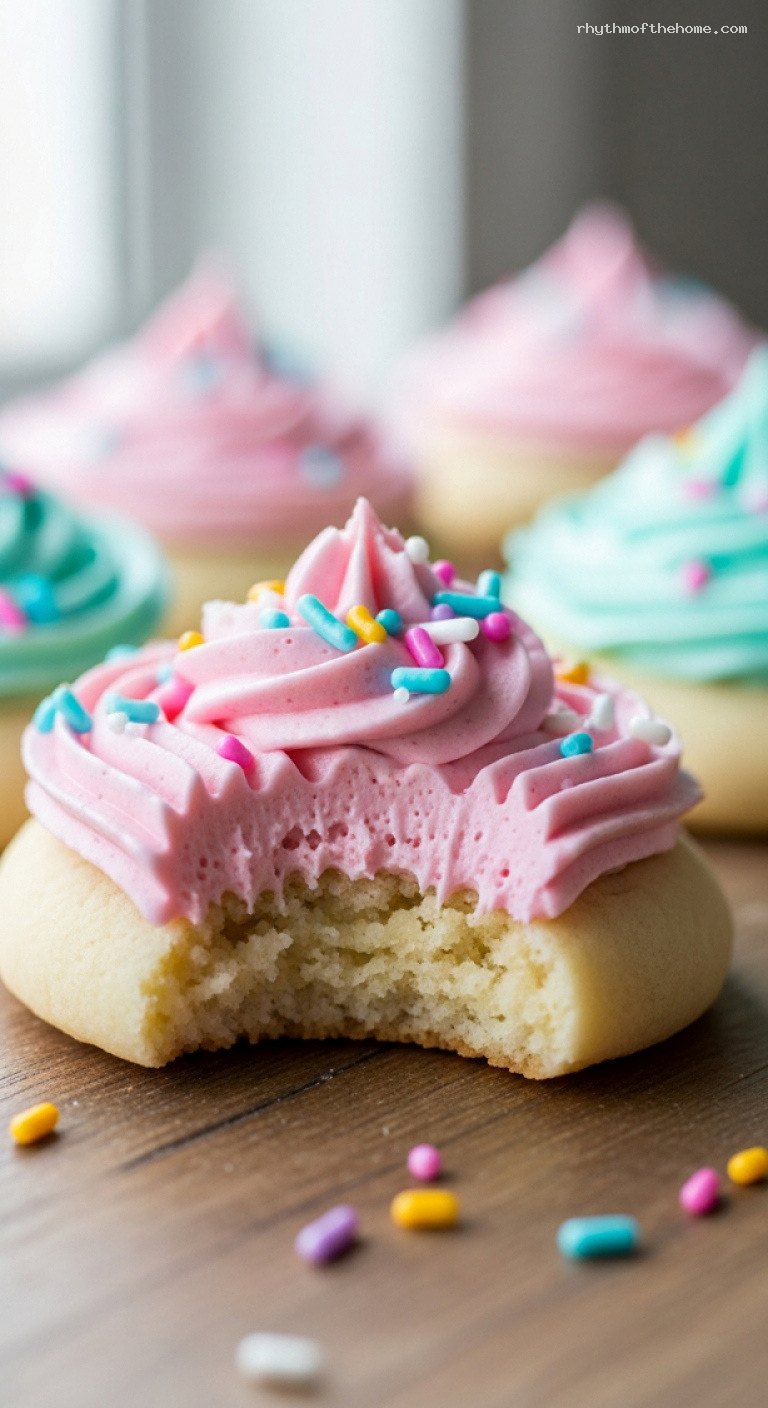
- Soft, thick sugar cookies with tender, almost cake-like centers and lightly crisp edges.
- Rich, fluffy buttercream piled on thick and tinted in any colors to match the occasion.
- Perfect make-ahead treat: dough chills beautifully and frosted cookies store and freeze well.
- Simple, homey ingredients but bakery-level results that are ideal for holidays, birthdays, or decorating parties.
Grocery List
- Produce: 1 lemon or orange (optional, for zest in dough or frosting)
- Dairy: Unsalted butter (2 cups / 4 sticks), sour cream, heavy cream or whole milk, 1 dozen large eggs (you will use 1 egg + 1 yolk)
- Pantry: All-purpose flour, granulated sugar, powdered (confectioners’) sugar, baking powder, fine salt, vanilla extract, almond extract (optional), gel food coloring, assorted sprinkles, parchment paper
Full Ingredients
For the Soft Sugar Cookies
- 2 3/4 cups (330 g) all-purpose flour, spooned and leveled
- 1 1/2 tsp baking powder
- 1/2 tsp fine sea salt
- 1 cup (226 g) unsalted butter, at room temperature
- 1 1/4 cups (250 g) granulated sugar
- 1 large egg, at room temperature
- 1 large egg yolk, at room temperature
- 2 1/2 tsp pure vanilla extract
- 1/4 tsp almond extract (optional, for classic bakery flavor)
- 2 tbsp full-fat sour cream (or full-fat plain Greek yogurt)
- Finely grated zest of 1/2 lemon or orange (optional, for a subtle citrus note)
For the Thick Buttercream Frosting
- 1 cup (226 g) unsalted butter, at room temperature
- 3 1/2 cups (420 g) powdered (confectioners’) sugar, sifted
- 2 tsp pure vanilla extract
- 1/8 tsp fine sea salt (or to taste)
- 2–3 tbsp heavy cream or whole milk (start with 2, add more as needed)
- Optional: 1–2 tsp fresh lemon juice or 1/4 tsp almond extract, to taste
For Coloring & Decorating
- Gel food coloring in 2–4 colors (pastels work beautifully: pink, mint, pale yellow, lavender)
- Assorted sprinkles (jimmies, nonpareils, sanding sugar, holiday mixes)
- Optional: small piping bags and star or round piping tips for swirls and rosettes
Step-by-Step Instructions
Step 1: Prepare your baking equipment
Line 2 large baking sheets with parchment paper and set them aside. If you plan to bake in multiple batches, have a third sheet ready so you can keep cookies moving in and out of the oven efficiently.
Preheat your oven to 350°F (175°C) but wait to bake until after the dough has chilled. While the oven is still off, move an oven rack to the center position for the most even baking.
Measure all ingredients accurately, ideally by weight for the flour and sugars. Having everything ready to go will help you avoid overmixing once you start combining the wet and dry ingredients.
Step 2: Mix the dry ingredients
In a medium bowl, whisk together the flour, baking powder, and salt until fully combined and no streaks of leavening remain. This ensures that the cookies rise evenly and stay tender.
If using citrus zest in the dough, you can whisk it into the dry ingredients or rub it into the sugar in the next step for extra fragrance. Set the dry mixture aside while you prepare the creamed butter and sugar.
Step 3: Cream butter and sugar, then add eggs and flavorings
In a large mixing bowl, using a hand mixer or stand mixer fitted with the paddle attachment, beat 1 cup (226 g) softened butter on medium speed until smooth and creamy, about 1 minute. Add the granulated sugar and beat on medium-high speed until light, fluffy, and slightly paler in color, 2–3 minutes. Scrape down the bowl as needed.
Add the egg and egg yolk one at a time, mixing well after each addition. Beat in the vanilla extract, almond extract (if using), sour cream, and optional citrus zest until the mixture looks smooth and slightly thickened, about 30–60 seconds more. Avoid overbeating once the eggs are in; too much air can make cookies puff and then deflate.
Step 4: Combine wet and dry ingredients and chill the dough
With the mixer on low speed, add the dry ingredients in 2–3 additions, mixing just until no dry flour remains. The dough will be soft but not sticky and should start to pull away from the sides of the bowl. If it feels very sticky, add 1–2 tbsp additional flour, mixing briefly to incorporate.
Divide the dough into two equal portions. Flatten each into a disc about 1 inch thick, wrap tightly in plastic wrap, and refrigerate for at least 1 hour, or up to 24 hours. This resting time firms up the butter, relaxes the gluten, and helps the cookies hold their shape while staying thick and soft.
Step 5: Roll, cut, and bake the cookies
Once the dough is well chilled, preheat the oven to 350°F (175°C) if you have not already. Place one dough disc on a lightly floured surface or between two sheets of parchment paper. Roll to an even 1/4 inch thickness. Thicker dough means softer, more tender cookies that can support lots of frosting.
Use cookie cutters to cut out shapes, closely spacing them to minimize scraps. Transfer cookies to the prepared baking sheets, leaving about 1 1/2 inches between each. Gather and reroll scraps only once or twice to avoid tough cookies.
Bake one sheet at a time on the center rack for 8–10 minutes, just until the edges look set and the tops are no longer shiny. The cookies should remain very pale with only the faintest hint of color at the edges. Do not wait for golden brown; that will make them dry and crisp instead of soft.
Cool on the baking sheet for 5 minutes, then carefully transfer to a wire rack to cool completely. Repeat with remaining dough.
Step 6: Make the thick buttercream frosting
While the cookies cool, prepare the buttercream. In a large bowl, beat 1 cup (226 g) softened butter on medium speed until very smooth and creamy, about 1–2 minutes. Gradually add the sifted powdered sugar, 1/2 cup at a time, mixing on low speed after each addition until mostly incorporated. This helps prevent a sugar cloud in your kitchen.
Once all the powdered sugar is in, add the vanilla extract, salt, and 2 tbsp heavy cream or milk. Increase the mixer speed to medium-high and beat for 2–3 minutes, until the frosting is very light, fluffy, and thick. If it seems too stiff to spread, add more cream or milk, 1 tsp at a time. If it is too soft, beat in an extra 2–4 tbsp powdered sugar.
Taste and, if you like, add a splash of lemon juice or a tiny bit of almond extract for a subtle twist. The ideal texture is thick enough to hold peaks but soft enough to spread smoothly.
Step 7: Color, decorate, and let the frosting set
Divide the buttercream into 2–4 bowls, depending on how many colors you want. Add a tiny amount of gel food coloring to each bowl using a toothpick; gel is concentrated, so start with less than you think you need. Stir well until the color is even, then adjust as desired. Pastel shades work beautifully against the pale cookies.
Once the cookies are completely cool, either spread a generous layer of frosting on each cookie with an offset spatula or butter knife, or transfer the frosting to piping bags fitted with star or round tips to pipe swirls, rosettes, or borders. Aim for a thick, noticeable layer of frosting on each cookie.
Immediately top with sprinkles so they adhere before the frosting begins to crust. Let the decorated cookies rest at room temperature for 30–60 minutes so the frosting can set slightly before stacking, storing, or transporting.
Pro Tips
- Do not skip chilling the dough; 1 hour in the fridge keeps the cookies thick, helps them hold their shape, and improves flavor.
- Roll the dough evenly to exactly 1/4 inch; uneven thickness leads to uneven baking and texture.
- Pull the cookies from the oven while they still look pale and barely set in the center; they will finish cooking on the hot pan.
- Use gel food coloring, not liquid, to avoid thinning the frosting and to achieve more vibrant colors with less dye.
- For ultra-smooth buttercream, sift the powdered sugar and beat the frosting for the full 2–3 minutes to incorporate air and dissolve any tiny sugar grains.
Variations
- Lemon sugar cookies: Add 1–2 tbsp lemon zest to the cookie dough and 1–2 tbsp lemon juice to the frosting. Tint the frosting pale yellow and decorate with yellow sprinkles or sparkling sugar.
- Chocolate twist: Replace 1/4 cup (30 g) of the flour with unsweetened cocoa powder for a lightly chocolate cookie, or add 2–3 tbsp cocoa powder to half of the buttercream for a two-tone swirl effect.
- Holiday shapes and colors: Use themed cutters (hearts, trees, eggs, stars) and coordinate the frosting colors and sprinkle mixes to suit birthdays, holidays, or team colors.
Storage & Make-Ahead
Unfrosted cookies keep well in an airtight container at room temperature for up to 4 days. Frosted cookies keep at cool room temperature for 2 days or in the refrigerator for up to 5 days; bring them to room temperature before serving for the softest texture.
The cookie dough can be wrapped tightly and refrigerated for up to 24 hours. If it becomes very firm, let it sit at room temperature for 10–15 minutes before rolling. You can also freeze the dough (well wrapped) for up to 2 months; thaw overnight in the refrigerator before rolling and baking.
To freeze finished cookies, first chill them on a baking sheet until the frosting is firm, then layer in an airtight container with parchment between layers. Freeze for up to 2 months. Thaw in the container at room temperature for several hours before serving.
Nutrition (per serving)
Approximate per frosted cookie (1 of 24): about 300 calories, 14 g fat, 8 g saturated fat, 42 g carbohydrates, 1 g fiber, 26 g sugar, 3 g protein, and 170 mg sodium. These values are estimates and will vary based on cookie size, frosting thickness, and specific brands used.

Leave a Reply