
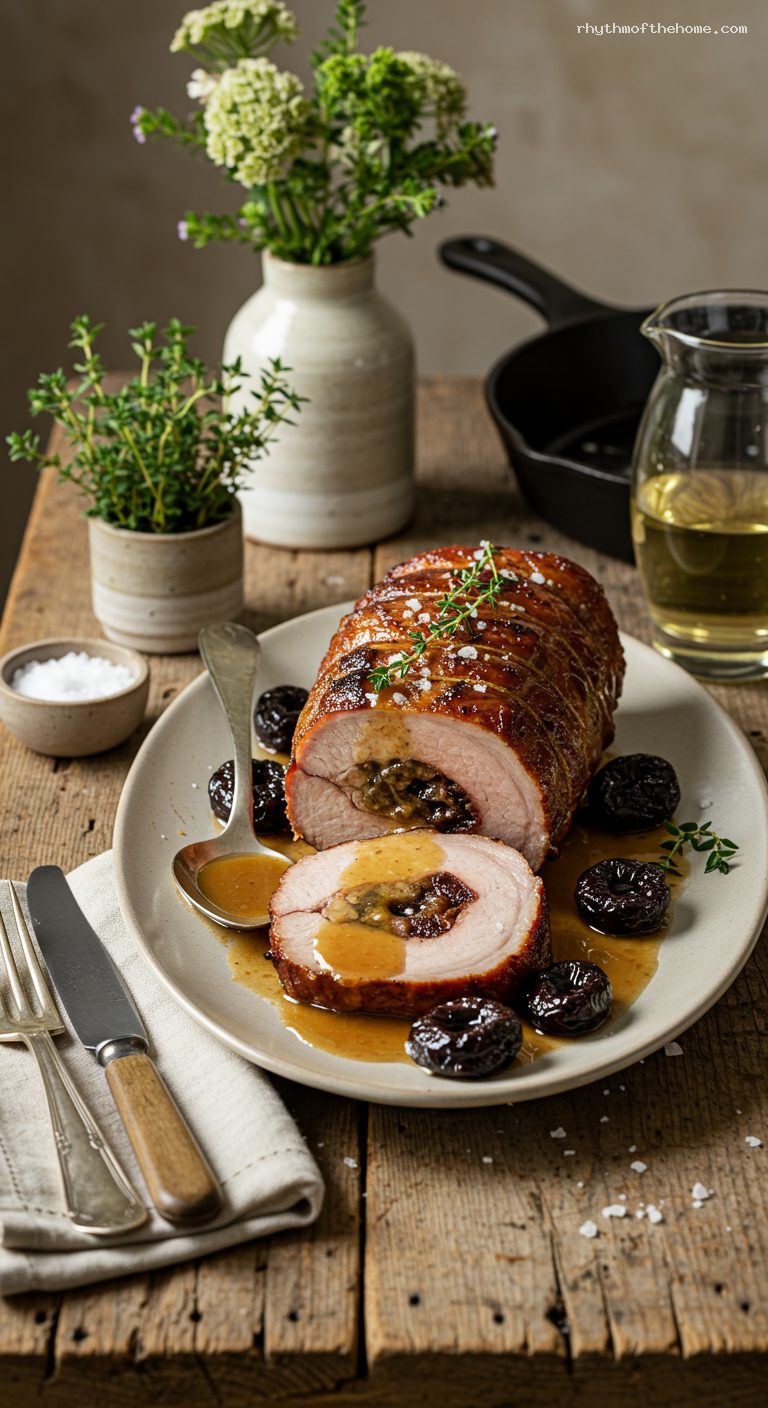
Quick Recipe Version (TL;DR)
Quick Ingredients
- 1 boneless center-cut pork loin roast, 2.5 to 3 lb
- 16 large pitted prunes (about 6 oz)
- 1/2 cup very hot water + 2 tbsp apple brandy (optional), for soaking prunes
- 2 1/2 tsp kosher salt; 1 1/2 tsp black pepper
- 2 tbsp olive oil, divided
- 1 tbsp Dijon mustard; 2 tsp fresh thyme, chopped
- 1 large shallot, finely chopped; 1 garlic clove, minced
- 1/2 cup dry white wine (or hard cider)
- 1 cup low-sodium chicken stock
- 2 tbsp unsalted butter, cold
- 1 tsp apple cider vinegar; 1 tsp Dijon (for sauce)
- 3 to 4 thyme sprigs; 1 bay leaf; flaky sea salt for finishing
Do This
- 1. Heat oven to 375°F (190°C). Soak prunes in very hot water and optional brandy for 10 minutes, then pat dry.
- 2. Tunnel a channel through the pork lengthwise with a long knife; widen with a wooden spoon handle. Push prunes in end-to-end to form a core.
- 3. Tie roast every 1 inch with kitchen twine. Rub with 1 tbsp olive oil, 1 tbsp Dijon, salt, pepper, and chopped thyme.
- 4. Sear in an oven-safe skillet over medium-high heat with remaining 1 tbsp oil until deeply browned, 8 to 10 minutes total.
- 5. Roast until 138 to 140°F (59 to 60°C) at the center, 45 to 60 minutes. Rest 15 minutes.
- 6. Make pan jus: sauté shallot and garlic in the skillet, deglaze with wine, reduce; add stock, thyme, bay, reduce 5 to 7 minutes. Whisk in Dijon and vinegar; off heat, swirl in butter.
- 7. Slice 1/2-inch thick to reveal the prune core. Spoon over jus, finish with flaky salt and a tuft of fresh thyme.
Why You’ll Love This Recipe
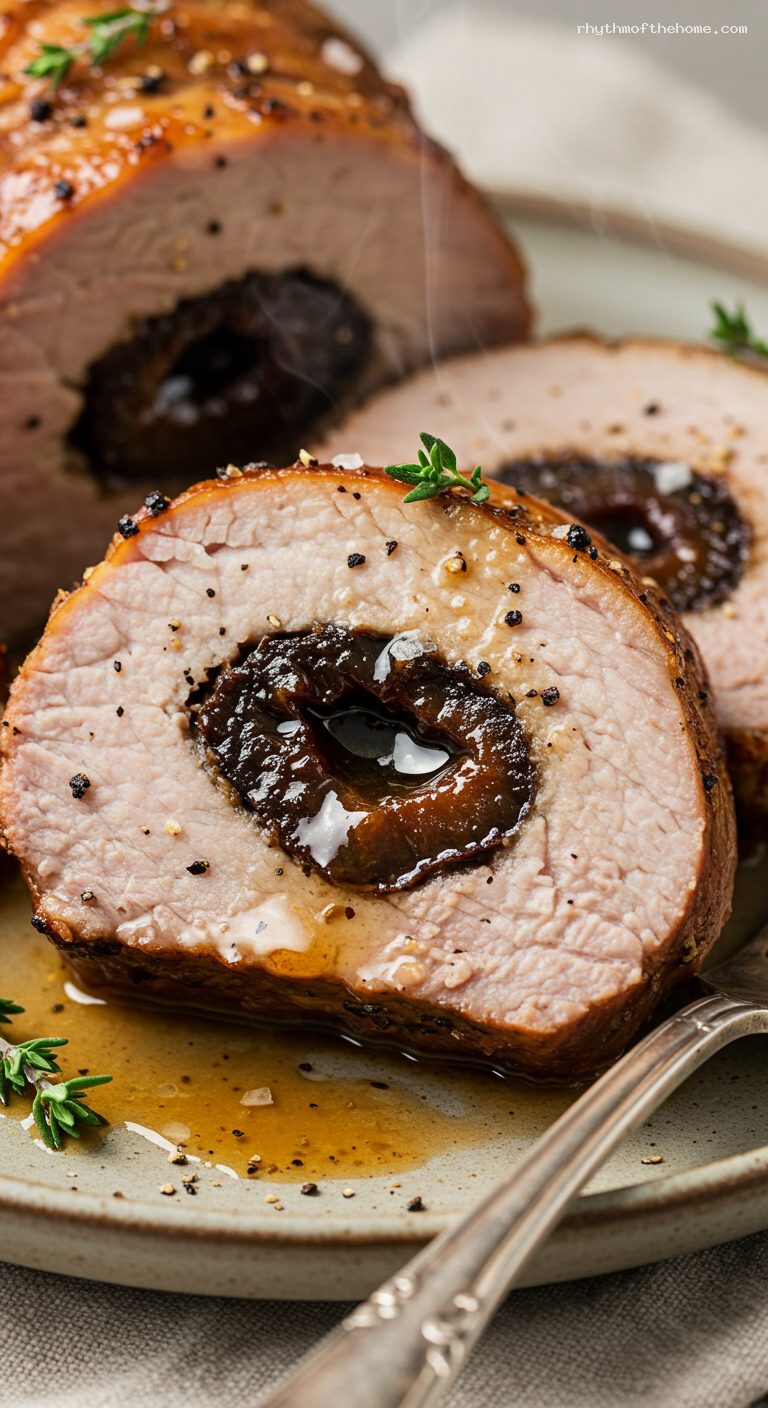
- Every slice reveals a jewel-like prune center for a sweet-savory surprise.
- Searing then roasting keeps the pork juicy and the crust beautifully caramelized.
- Quick pan jus made right in the roasting skillet adds glossy, restaurant-quality flavor.
- Elegant enough for dinner parties, simple enough for a cozy weekend meal.
Grocery List
- Produce: Shallot, garlic, fresh thyme, bay leaf
- Dairy: Unsalted butter
- Pantry: Pork loin roast, pitted prunes, olive oil, kosher salt, black pepper, Dijon mustard, dry white wine or hard cider, low-sodium chicken stock, apple cider vinegar, apple brandy (optional), flaky sea salt, kitchen twine
Full Ingredients
Pork and Prune Core
- 1 boneless center-cut pork loin roast, 2.5 to 3 lb
- 16 large pitted prunes (about 6 oz)
- 1/2 cup very hot water (for soaking prunes)
- 2 tbsp apple brandy or dry white wine (optional, for soaking)
Seasoning and Searing
- 2 1/2 tsp kosher salt
- 1 1/2 tsp freshly ground black pepper
- 2 tbsp extra-virgin olive oil, divided
- 1 tbsp Dijon mustard
- 2 tsp fresh thyme leaves, finely chopped
- Kitchen twine (for tying)
Pan Jus
- 1 large shallot, finely chopped
- 1 garlic clove, minced
- 1/2 cup dry white wine or hard cider
- 2 tbsp apple brandy or Calvados (optional)
- 1 cup low-sodium chicken stock
- 3 to 4 fresh thyme sprigs
- 1 bay leaf
- 1 tsp Dijon mustard
- 1 tsp apple cider vinegar
- 2 tbsp unsalted butter, cold, cut into small cubes
- Salt and pepper to taste
To Serve
- Flaky sea salt, for finishing
- Fresh thyme sprigs (a small tuft on top of the sliced roast)
Step-by-Step Instructions
Step 1: Preheat and plump the prunes
Preheat the oven to 375°F (190°C). Place the prunes in a heatproof bowl and cover with 1/2 cup very hot water; add 2 tbsp apple brandy if using. Let soak for 10 minutes to soften, then drain well and pat completely dry with paper towels so they will pack tightly and the roast will sear properly.
Step 2: Create the tunnel and stuff the prune core
Set the pork loin on a cutting board. Using a long, thin knife, carefully make a lengthwise slit down the center from one end, aiming to keep the blade centered and parallel to the board. Work the knife tip to create a tunnel nearly the length of the roast, then gently widen it with the handle of a wooden spoon. Push the softened prunes into the tunnel end-to-end to form a continuous core. If a prune is too large, slice it in half lengthwise to fit snugly.
Step 3: Tie and season the roast
Cut 6 to 7 lengths of kitchen twine and tie the roast at 1-inch intervals to hold its shape and keep the core centered. In a small bowl, mix 1 tbsp olive oil with 1 tbsp Dijon, the chopped thyme, salt, and pepper. Pat the pork dry and rub the mixture all over the roast.
Step 4: Sear for a flavorful crust
Heat an oven-safe 12-inch skillet (cast iron or stainless) over medium-high heat. Add the remaining 1 tbsp olive oil. Sear the pork on all sides until deeply browned, 8 to 10 minutes total, turning with tongs. Position the roast seam side down in the skillet when finished.
Step 5: Roast to juicy perfection
Transfer the skillet to the oven and roast until an instant-read thermometer inserted into the thickest part (avoid the prune core) registers 138 to 140°F (59 to 60°C), about 45 to 60 minutes, depending on thickness. Rotate the skillet halfway through for even cooking. Transfer the roast to a cutting board, tent loosely with foil, and rest for 15 minutes (temperature will rise to about 145°F/63°C).
Step 6: Build the pan jus
Place the skillet over medium heat and pour off excess fat, leaving the flavorful browned bits. Add the shallot and cook 1 to 2 minutes until translucent, stirring to release fond. Stir in the garlic and cook 30 seconds until fragrant. Deglaze with the wine (and optional brandy), scraping up browned bits; simmer until nearly evaporated, about 2 to 3 minutes. Add the stock, thyme sprigs, and bay leaf; simmer briskly until reduced to about 3/4 cup, 5 to 7 minutes. Whisk in 1 tsp Dijon and the vinegar; remove thyme and bay. Off heat, whisk in the cold butter until the sauce turns glossy. Season to taste with salt and pepper.
Step 7: Slice and serve
Remove the twine. Slice the pork crosswise into 1/2-inch-thick slices so each piece reveals the sweet prune core. Arrange on a warm platter, spoon over the pan jus, finish with a pinch of flaky sea salt, and top with a small tuft of fresh thyme. Serve immediately.
Pro Tips
- Use a wooden spoon handle to gently widen the tunnel; it makes stuffing the prunes easier and keeps the core centered.
- Tie firmly but not too tight—over-tightening can squeeze out juices and deform the prune channel.
- Always take the internal temperature away from the prune core to get an accurate reading.
- If the fond darkens too quickly during searing, reduce the heat slightly; you want deep brown, not black.
- Warm your serving platter in the oven during the roast to help keep the sliced pork juicy at the table.
Variations
- Apricot and almond: Swap prunes for dried apricots and add 2 tbsp finely chopped toasted almonds to the core; finish the sauce with a splash of orange liqueur.
- Herb and fennel: Add 1 tsp crushed fennel seed and 1 tsp lemon zest to the rub; garnish with rosemary instead of thyme.
- Bacon-wrapped: Wrap the tied roast with 6 to 8 bacon slices before searing; roast until the bacon is crisp and the pork reaches temp (add 5 to 10 minutes as needed).
Storage & Make-Ahead
To make ahead, stuff and tie the roast up to 24 hours in advance, season, and refrigerate uncovered to dry-brine. Remove from the fridge 45 minutes before cooking. Leftovers keep well: refrigerate sliced pork and jus in separate airtight containers up to 4 days, or freeze up to 2 months. Reheat gently at 275°F (135°C), covered with a splash of stock, 15 to 20 minutes, or warm slices in a skillet with a spoonful of jus until just heated through. Do not boil the finished sauce after mounting with butter to preserve its silky texture.
Nutrition (per serving)
Approximate values for 1/6 of the recipe with sauce: 470 calories; 45 g protein; 20 g fat; 22 g carbohydrates; 2 g fiber; 780 mg sodium.

Leave a Reply