
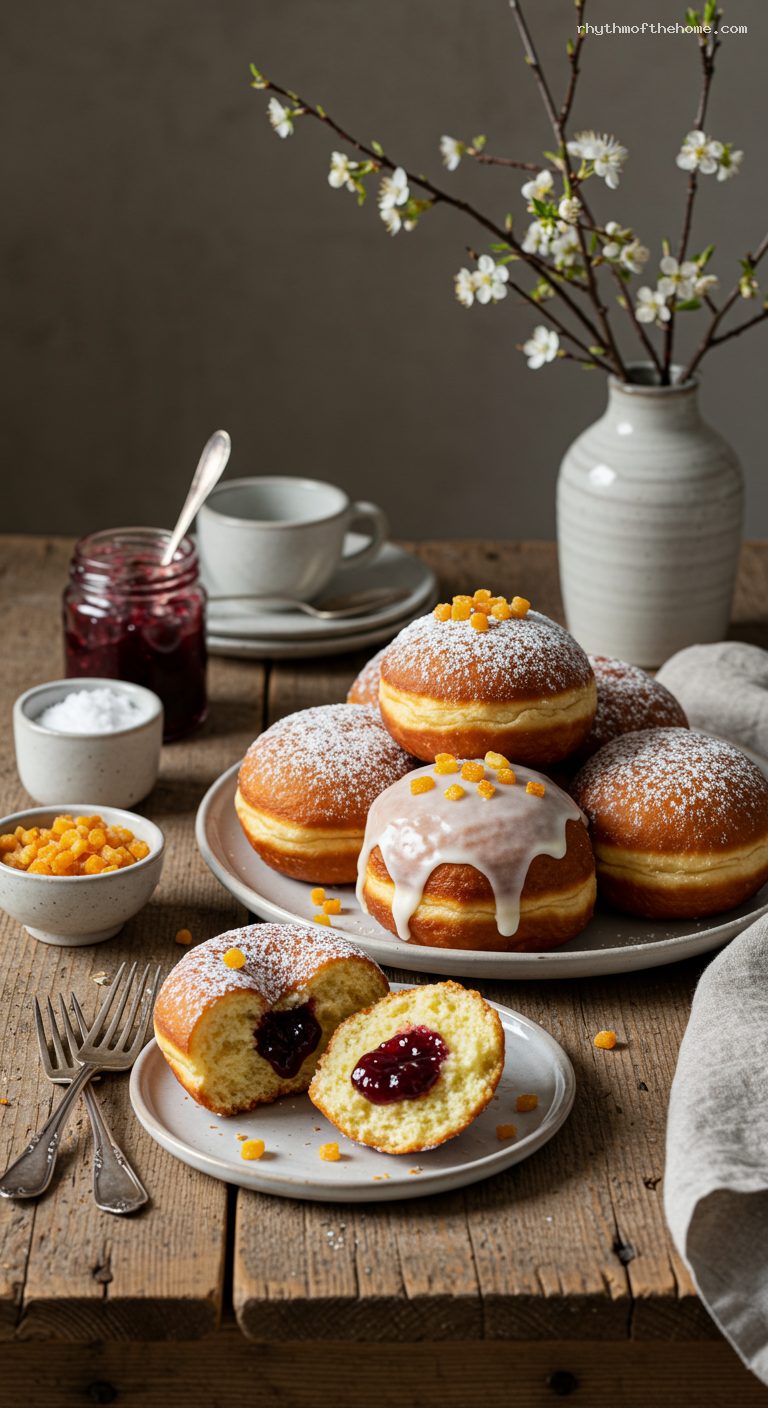
Quick Recipe Version (TL;DR)
Quick Ingredients
- 500 g all-purpose flour (4 cups), plus extra for dusting
- 60 g sugar (1/3 cup)
- 7 g instant or active dry yeast (2 1/4 tsp)
- 1 tsp fine salt
- 4 large egg yolks
- 240 ml warm whole milk, 38–43°C (1 cup)
- 80 g very soft unsalted butter (6 tbsp)
- 1 tbsp rum or neutral spirit
- 1 tsp vanilla extract; 1 tsp lemon zest (optional)
- 1.5–2 L neutral oil for frying
- 300 g rosehip or plum jam (1 1/4 cups), room temp
- Dusting: 60 g powdered sugar (1/2 cup)
- or Glaze: 180 g powdered sugar + 2–3 tbsp lemon juice or milk
- 30 g candied orange peel, finely diced
Do This
- 1. Mix flour, sugar, yeast, and salt; add warm milk, yolks, vanilla, zest, and rum. Knead 2–3 min, then knead in butter 8–10 min until smooth.
- 2. Let rise covered until doubled, 60–90 min at warm room temp.
- 3. Divide into 16 pieces (55–60 g). Shape tight balls; set on floured parchment squares. Proof 30–45 min until puffy.
- 4. Heat oil to 170–175°C (340–350°F). Prepare paper-lined tray and a piping bag with long tip.
- 5. Fry 1.5–2 min per side until deep golden with a pale ring. Drain well.
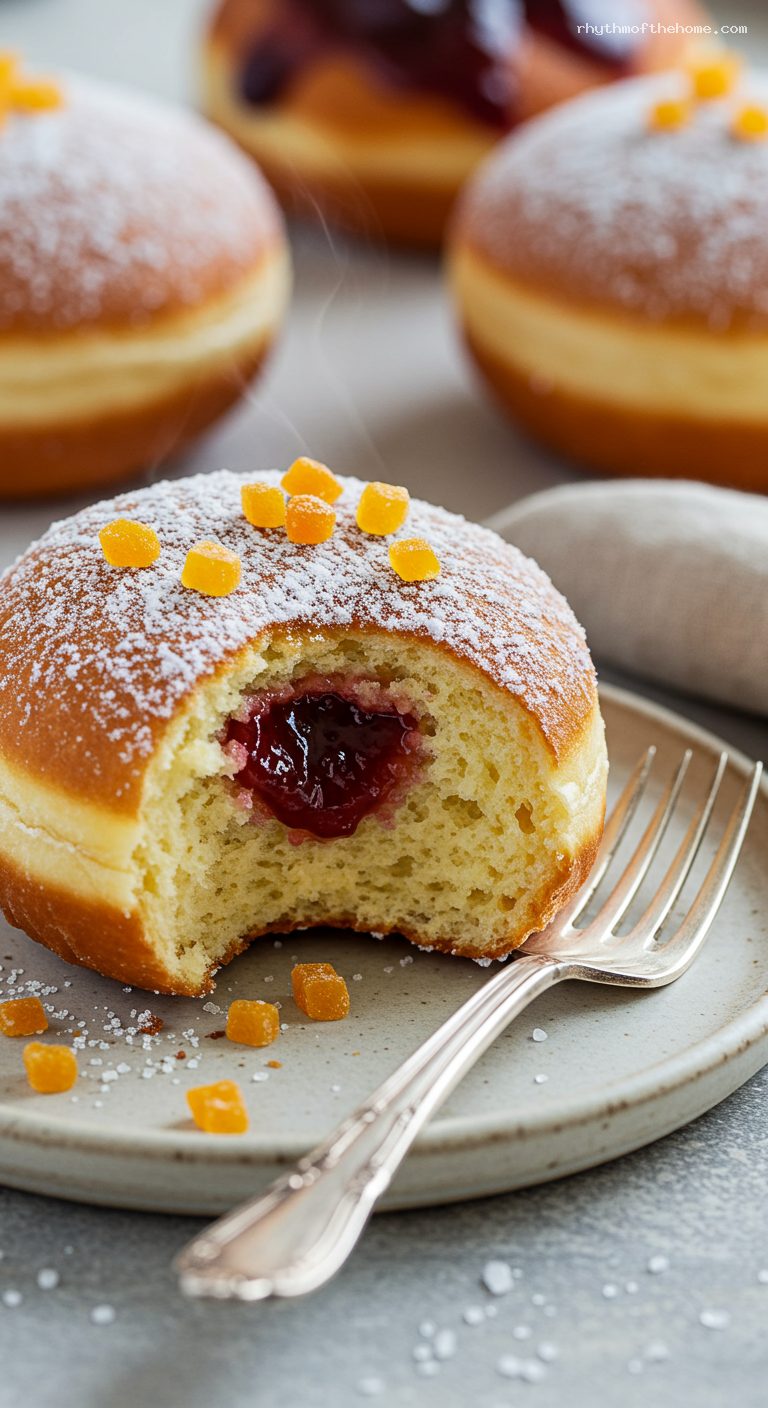
- 6. Fill each with 1–1.5 tbsp jam. Dust with powdered sugar or dip in light icing; finish with candied orange peel.
Why You’ll Love This Recipe
- Airy, tender crumb from a classic enriched dough with yolks and butter.
- Traditional flavors: rosehip or plum jam and a whisper of citrus.
- Reliable frying temperatures and proofing cues for stress-free results.
- Two easy finishes: snowy sugar or a thin, glossy lemon icing with candied orange peel.
Grocery List
- Produce: 1 lemon (zest and juice), candied orange peel (or oranges if making your own peel)
- Dairy: Whole milk, unsalted butter, 4 large eggs (yolks only)
- Pantry: All-purpose flour, granulated sugar, powdered sugar, instant or active dry yeast, vanilla extract, rum or neutral spirit, fine salt, neutral frying oil, rosehip jam or plum jam
Full Ingredients
Dough
- 500 g all-purpose flour (about 4 cups, leveled)
- 60 g granulated sugar (1/3 cup)
- 7 g instant or active dry yeast (2 1/4 tsp)
- 1 tsp fine sea salt (about 6 g)
- 4 large egg yolks (72–80 g)
- 240 ml whole milk, warmed to 38–43°C / 100–110°F (1 cup)
- 80 g unsalted butter, very soft (6 tbsp)
- 1 tbsp rum or neutral spirit (15 ml)
- 1 tsp vanilla extract (5 ml)
- 1 tsp finely grated lemon zest (optional but lovely)
For Frying
- 1.5–2 liters neutral oil (canola, peanut, or refined sunflower)
Fillings
- 300 g thick rosehip jam or plum jam/powidła (about 1 1/4 cups), at room temperature
- Optional: 1–2 tsp water or rum to loosen if your jam is very stiff
Finishes
- Powdered Sugar: 60 g confectioners’ sugar (1/2 cup)
- Light Icing: 180 g confectioners’ sugar (1 1/2 cups), 2–3 tbsp fresh lemon juice or milk, pinch of salt, 1/2 tsp vanilla extract
- Candied Orange Peel: 30 g (about 1/4 cup), finely diced
Step-by-Step Instructions
Step 1: Make the enriched dough
In a large bowl or the bowl of a stand mixer, whisk together the flour, sugar, yeast, and salt. Add the warm milk, egg yolks, vanilla, lemon zest, and rum. Mix on low until a shaggy dough forms, 2–3 minutes. With the mixer running, add the very soft butter in 3 additions, letting each portion fully incorporate. Increase to medium and knead until the dough is smooth, elastic, and slightly tacky but clears the bowl, 8–10 minutes. If kneading by hand, expect 10–12 minutes. If using active dry yeast, dissolve it in the warm milk with a pinch of sugar first and let stand 5–10 minutes until foamy, then proceed.
Step 2: First rise
Form the dough into a ball and place in a lightly greased bowl. Cover and let rise in a warm, draft-free spot until doubled in size, 60–90 minutes. Ideal dough temperature is about 26–27°C (79–81°F).
Step 3: Divide and shape
Turn the dough onto a lightly floured surface and gently press out air. Divide into 16 equal pieces (55–60 g each). Cup your hand over each piece and roll into a tight ball, creating surface tension. Place each ball, seam-side down, on a small square of lightly floured parchment. Gently press to about 2.5 cm (1 inch) thick. Cover loosely with a clean towel.
Step 4: Proof until puffy
Let the doughnuts proof until noticeably puffy and very light, 30–45 minutes. They should slowly spring back when gently poked, leaving a faint indentation. While they proof, fit a piping bag with a long bismarck tip (or a small round tip) and fill with jam. Prepare a paper towel–lined tray for draining.
Step 5: Heat the oil
Pour oil into a deep, heavy pot to a depth of 5–7.5 cm (2–3 inches). Heat to 170–175°C (340–350°F) over medium heat. Maintain this range throughout frying; adjust the burner as needed. A clip-on thermometer is invaluable.
Step 6: Fry to deep golden
Working in batches, slide doughnuts into the oil using their parchment squares; peel the parchment away with tongs. Fry 1.5–2 minutes per side until rich golden-brown with a lighter ring around the middle. Avoid crowding. Transfer to the paper-lined tray to drain. If using powdered sugar, let cool 5 minutes before dusting. If glazing, proceed while still slightly warm so the icing sets thinly and smooth.
Step 7: Fill and finish
Use a skewer to make a small tunnel from the side into the center of each doughnut. Insert the bismarck tip and pipe 1–1.5 tbsp (20–25 g) jam into each one until you feel gentle resistance. Finish with a heavy snowfall of powdered sugar or dip the tops into the light icing. Immediately sprinkle with finely diced candied orange peel so it adheres. Let set 10 minutes before serving.
Pro Tips
- Add the butter slowly after gluten begins to form; this helps the dough strengthen and stay airy.
- The rum or neutral spirit reduces oil absorption and leaves no boozy taste.
- Proof fully before frying; under-proofed doughnuts will be dense and may split.
- Keep oil at 170–175°C; too hot browns the exterior before the center cooks, too cool yields greasy doughnuts.
- Use a thick jam; if it is runny, reduce it gently on the stove or whisk in a little powdered pectin to set.
Variations
- Cream-Filled: Swap jam for thick pastry cream or vanilla diplomat cream; dust with powdered sugar.
- Rosewater Glaze: Replace half the lemon juice with 1–2 tsp rosewater for a floral note that pairs beautifully with rosehip jam.
- Cinnamon Sugar: Skip the icing; roll warm doughnuts in 200 g sugar mixed with 2 tsp cinnamon.
Storage & Make-Ahead
Best the day they are fried. Store leftover filled doughnuts in an airtight container at room temperature for up to 24 hours. To refresh, warm in a 150°C (300°F) oven for 5–7 minutes. For make-ahead, shape the dough balls, place on parchment-lined trays, cover, and refrigerate up to 12 hours; let come to room temperature and finish proofing 45–60 minutes before frying. You can also freeze fried, unfilled doughnuts up to 1 month; thaw, rewarm, then fill and finish.
Nutrition (per serving)
Approximate for 1 of 16 doughnuts with jam and light icing: 360 kcal; 14 g fat; 51 g carbohydrates; 5 g protein; 160 mg sodium; 1 g fiber; 20 g sugars. Values will vary with frying oil absorption and finish.

Leave a Reply