
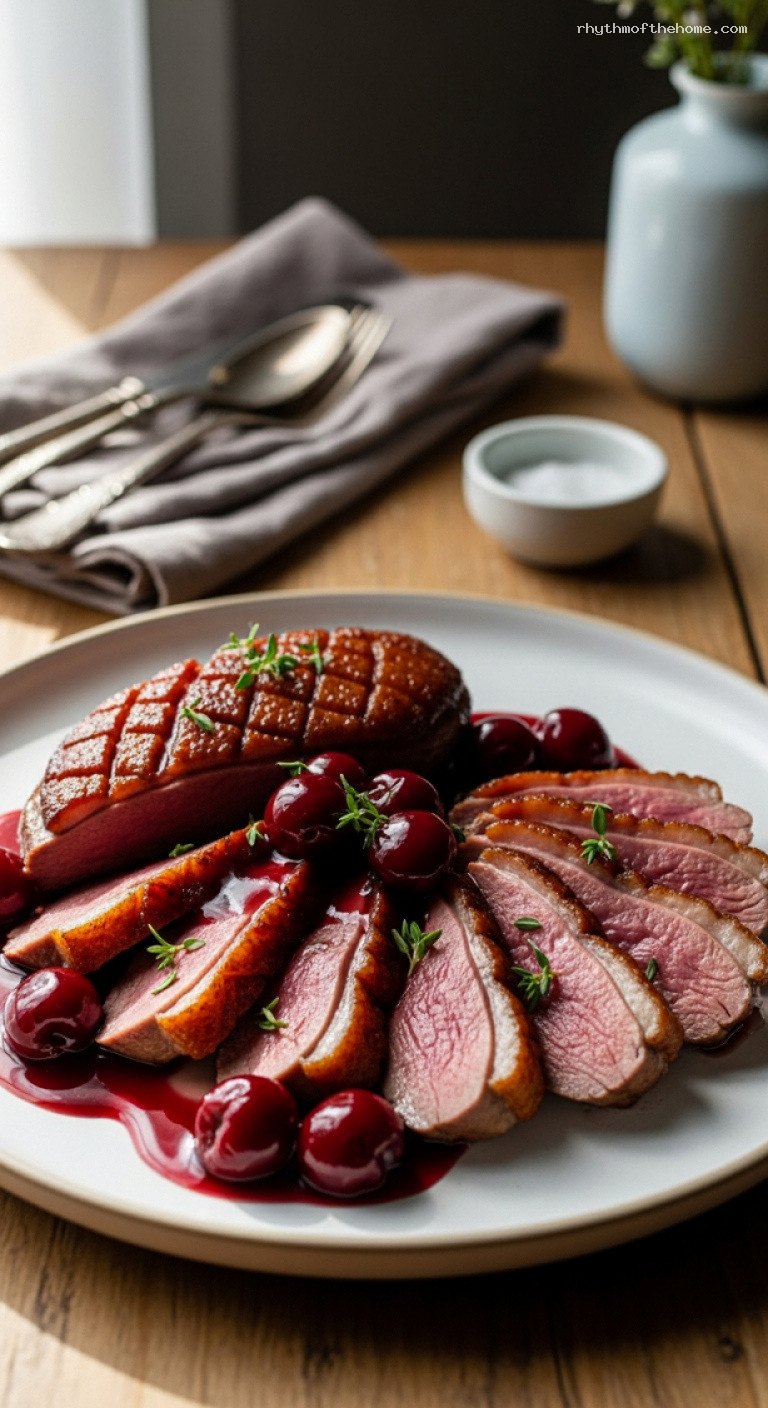
Quick Recipe Version (TL;DR)
Quick Ingredients
- 2 boneless duck breasts (6–8 oz / 170–225 g each), skin on
- 1 1/4 tsp kosher salt, divided
- 1/2 tsp freshly ground black pepper
- 1 tsp neutral oil (if needed)
- 1 small shallot, finely minced
- 1 small garlic clove, minced
- 1 cup (140 g) pitted tart cherries, fresh or frozen
- 1/2 cup (120 ml) dry red wine
- 1/3 cup (80 ml) low-sodium chicken stock
- 1–2 tsp sugar or honey (to taste)
- 1 tsp balsamic vinegar
- 1 tsp fresh thyme leaves (or 1/4 tsp dried)
- 1 Tbsp unsalted butter
Do This
- 1. Preheat oven to 400°F (200°C). Pat duck dry, score the skin in a crosshatch, and season all over with 1 tsp salt and pepper.
- 2. Place duck skin-side down in a cold oven-safe skillet. Turn heat to medium and cook 8–10 minutes until a deep golden, crispy fat cap forms.
- 3. Flip duck and sear 1–2 minutes, then transfer skillet to oven and roast 5–8 minutes, until internal temperature is 130–135°F (54–57°C) for medium-rare.
- 4. Transfer duck to a plate, tent loosely with foil, and rest 8–10 minutes.
- 5. Pour off most duck fat, leaving about 1 Tbsp in the skillet. Sauté shallot and garlic 1–2 minutes.
- 6. Add cherries, red wine, stock, remaining 1/4 tsp salt, sugar or honey, thyme, and balsamic. Simmer 8–10 minutes until syrupy, then whisk in butter.
- 7. Slice duck thinly, arrange on warm plates, and spoon cherry-red wine glaze generously over the top.
Why You’ll Love This Recipe
- Restaurant-style duck made completely doable in a home kitchen with simple, clear steps.
- Crispy, golden duck skin and tender, rosy meat balanced by a tangy-sweet cherry red wine glaze.
- Uses pantry-friendly ingredients and frozen cherries, so you can make it year-round.
- Perfect for date night or dinner guests, but fast enough for a special weeknight meal.
Grocery List
- Produce: 1 small shallot, 1 small garlic clove, 1 small bunch fresh thyme (optional but recommended)
- Dairy: Unsalted butter
- Pantry: Duck breasts (butcher or freezer section), pitted tart cherries (fresh or frozen), dry red wine, low-sodium chicken stock, balsamic vinegar, sugar or honey, kosher salt, black pepper, neutral cooking oil
Full Ingredients
For the Duck
- 2 boneless duck breasts (6–8 oz / 170–225 g each), skin on
- 1 tsp kosher salt
- 1/2 tsp freshly ground black pepper
- 1 tsp neutral oil (such as canola, grapeseed, or vegetable), only if needed to prevent sticking
For the Cherry–Red Wine Glaze
- 1 small shallot, finely minced (about 2 Tbsp)
- 1 small garlic clove, minced
- 1 cup (140 g) pitted tart cherries, fresh or frozen (no need to thaw)
- 1/2 cup (120 ml) dry red wine (such as Pinot Noir, Merlot, or Cabernet Sauvignon)
- 1/3 cup (80 ml) low-sodium chicken stock
- 1–2 tsp sugar or honey, to taste (start with 1 tsp)
- 1 tsp balsamic vinegar
- 1 tsp fresh thyme leaves, or 1 small sprig thyme (or 1/4 tsp dried thyme)
- 1/4 tsp kosher salt, plus more to taste
- Freshly ground black pepper, to taste
- 1 Tbsp unsalted butter, cold
Optional Garnishes & Serving Ideas
- Extra fresh thyme leaves
- Thin strips of orange zest (for a citrusy aroma)
- Flaky sea salt
- Serve with: creamy mashed potatoes, roasted potatoes, polenta, or a simple green salad
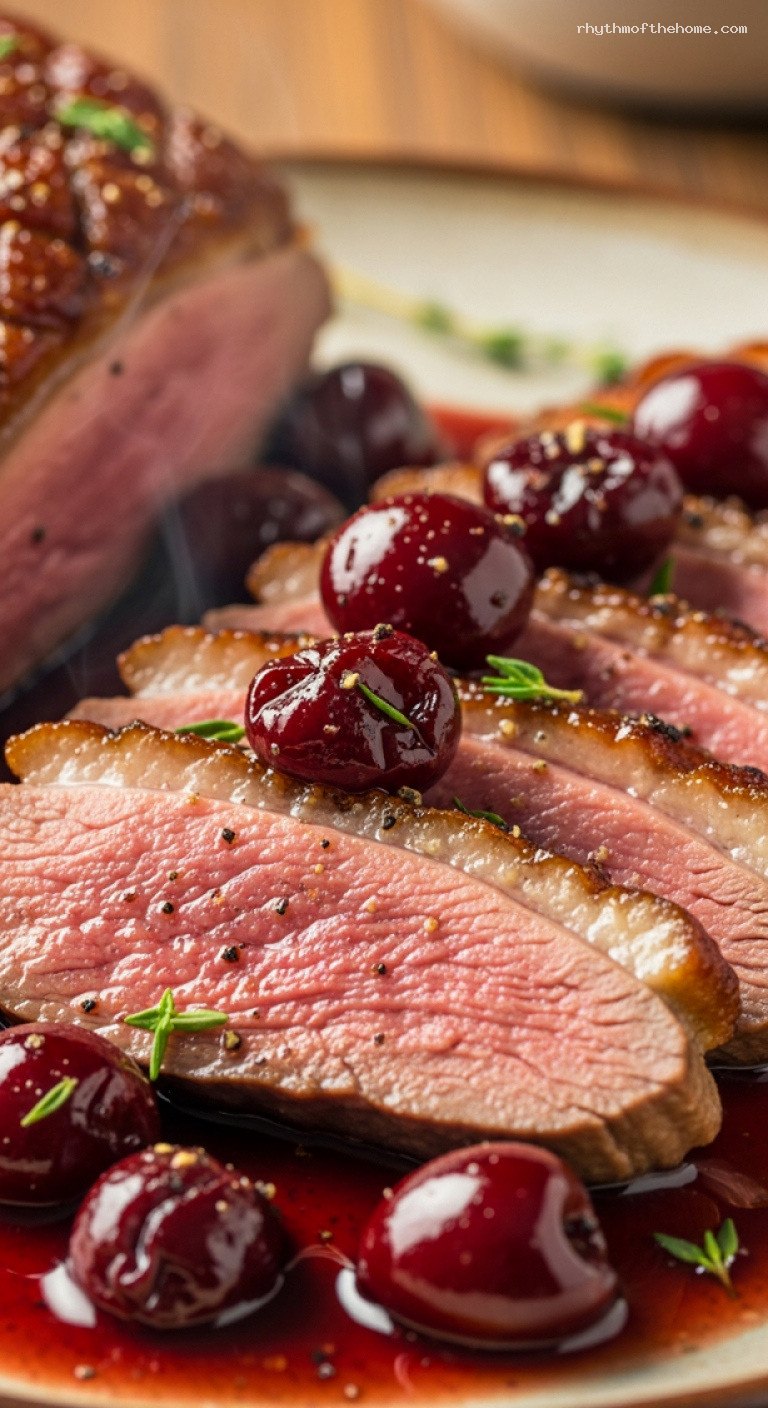
Step-by-Step Instructions
Step 1: Prep the Duck Breasts
Take the duck breasts out of the refrigerator 20–30 minutes before cooking so they are closer to room temperature; this helps them cook more evenly. Pat them very dry on both sides with paper towels. Dry skin is key to getting a really crispy finish.
Place a duck breast skin-side up on a cutting board. Using a sharp knife, lightly score the skin in a diagonal crosshatch pattern, making shallow cuts about 1/2 inch (1 cm) apart. Cut only through the skin and fat, not into the meat. Repeat with the second breast. Sprinkle both breasts all over with 1 tsp kosher salt and 1/2 tsp black pepper, rubbing it gently into the slits in the skin.
Step 2: Render and Crisp the Skin
Place a heavy, oven-safe skillet (cast iron or stainless steel) on the stove, but do not preheat it yet. Lay the duck breasts into the cold, dry skillet skin-side down. Starting in a cold pan lets the fat slowly render out and crisp the skin instead of burning it.
Turn the heat to medium. As the pan heats, you will hear gentle sizzling and see fat begin to pool around the duck. Let the duck cook undisturbed for 8–10 minutes, adjusting the heat as needed to maintain steady sizzling without smoking. Spoon off excess fat into a heatproof bowl if a very deep layer forms, leaving a shallow layer to help crisp the skin. The skin is ready when it is deeply golden-brown and very crisp to the touch.
Step 3: Sear the Flesh and Finish in the Oven
Once the skin is crisp, carefully flip the duck breasts so they are flesh-side down. Sear for 1–2 minutes, just to lightly brown the meat side. If the pan looks very dry at this point (it usually will not, thanks to the duck fat), you can add up to 1 tsp neutral oil.
Meanwhile, preheat your oven to 400°F (200°C) if you have not already. Transfer the skillet with the duck to the hot oven. Roast for 5–8 minutes, depending on thickness, until the internal temperature reaches 130–135°F (54–57°C) for medium-rare when checked with an instant-read thermometer inserted into the thickest part. For medium, aim for 140°F (60°C). Keep in mind the temperature will rise a few degrees as the duck rests.
Step 4: Rest the Duck Properly
Using tongs, transfer the duck breasts to a warm plate or cutting board, skin-side up. Tent loosely with foil and let them rest for 8–10 minutes. Resting allows the juices to redistribute so the meat stays moist instead of running out when you slice it.
While the duck rests, carefully pour most of the duck fat from the skillet into a heatproof container, leaving about 1 Tbsp in the pan for the sauce. You can save the extra rendered fat in the refrigerator for roasting potatoes or vegetables another day.
Step 5: Sauté the Aromatics
Place the skillet back on the stove over medium heat. If using stainless steel, you may see browned bits stuck to the bottom; these are full of flavor and will be incorporated into the sauce.
Add the minced shallot to the pan and cook, stirring frequently, for 1–2 minutes until it softens and becomes translucent. Add the minced garlic and cook for another 30 seconds, just until fragrant. Avoid browning the garlic, as it can turn bitter.
Step 6: Build the Cherry–Red Wine Reduction
Add the cherries to the skillet, along with any juices if using thawed frozen cherries. Pour in the red wine and chicken stock. Stir in 1 tsp sugar or honey, 1 tsp fresh thyme leaves (or the thyme sprig), 1/4 tsp kosher salt, and a few grinds of black pepper. Scrape the bottom of the pan with a wooden spoon to loosen any browned bits.
Increase the heat to medium-high and bring the mixture to a gentle boil, then reduce to a lively simmer. Cook for 8–10 minutes, stirring occasionally, until the liquid has reduced by about half and the cherries are soft and glossy. The sauce should be thick enough to lightly coat the back of a spoon. Taste and adjust: add up to 1 additional tsp sugar or honey if your cherries are very tart, and stir in 1 tsp balsamic vinegar for brightness.
Turn off the heat. Add the cold butter and swirl or whisk it into the sauce until fully melted and the glaze looks shiny and slightly thicker. Remove any thyme sprig if you used one. Taste once more and adjust salt and pepper as needed.
Step 7: Slice, Glaze, and Serve
Place the rested duck breasts skin-side up on a cutting board. Using a sharp knife, slice each breast crosswise into 1/4–1/2 inch (0.5–1.25 cm) thick slices. Aim to keep the crispy skin attached to each slice.
Arrange the slices slightly fanned out on warm plates or a serving platter. Spoon the cherry–red wine glaze generously over the duck, letting some sauce pool around the slices and a little cling to the top. If you like, set a few whole cherries on top for a pretty look. Garnish with extra fresh thyme leaves, a tiny pinch of flaky sea salt, or a few thin strips of orange zest. Serve immediately with your favorite sides, such as mashed potatoes, roasted vegetables, or a simple green salad.
Pro Tips
- Start with a cold pan: This is the single most important trick for ultra-crispy duck skin. The slow heat gives the fat time to render without burning.
- Mind the temperature: Duck is best served medium-rare to medium. An instant-read thermometer takes out the guesswork and prevents overcooking.
- Use frozen cherries year-round: Frozen tart cherries work beautifully and often have better flavor than out-of-season fresh fruit.
- Adjust sweetness to your taste: The exact sweetness needed depends on your cherries and wine. Start with less sugar or honey and add more only if needed.
- Warm the plates: Duck cools quickly. Serving on warm plates helps keep the meat and sauce at a pleasant temperature.
Variations
- Orange-cherry duck: Add 2 Tbsp fresh orange juice and 1 tsp finely grated orange zest to the sauce along with the wine for a brighter, citrusy twist.
- Herb and spice twist: Swap thyme for fresh rosemary, and add a small pinch of ground allspice or cinnamon to the sauce for a warm, aromatic note.
- No wine option: Replace the red wine with a mix of 1/4 cup (60 ml) extra chicken stock and 1/4 cup (60 ml) cherry juice or pomegranate juice. Add an extra 1–2 tsp balsamic vinegar to balance the sweetness.
Storage & Make-Ahead
For best texture, cook the duck right before serving, but you can still prep ahead. Score and season the duck breasts up to 24 hours in advance and keep them uncovered in the refrigerator; this dries the skin, helping it crisp better. The cherry–red wine glaze can be made up to 2 days ahead: cool completely, cover, and refrigerate. Reheat it gently over low heat, adding a splash of water or stock to loosen if needed, and whisk in a fresh teaspoon of cold butter right before serving for extra gloss.
Leftover cooked duck and sauce can be stored in separate airtight containers in the refrigerator for up to 3 days. Reheat the duck gently, skin-side up, in a 325°F (165°C) oven for 8–10 minutes, or until just warmed through; avoid microwaving if possible, as it will soften the skin. Reheat the sauce in a small saucepan over low heat, adding a spoonful of water or stock if it has thickened too much.
Nutrition (per serving)
Approximate values per serving (including sauce, based on 2 servings): 600 calories; 35 g protein; 38 g fat; 18 g saturated fat; 20 g carbohydrates; 2 g fiber; 15 g sugars; 600 mg sodium. Actual values will vary based on the exact size of the duck breasts, the amount of rendered fat discarded, and specific ingredient brands.

Leave a Reply