
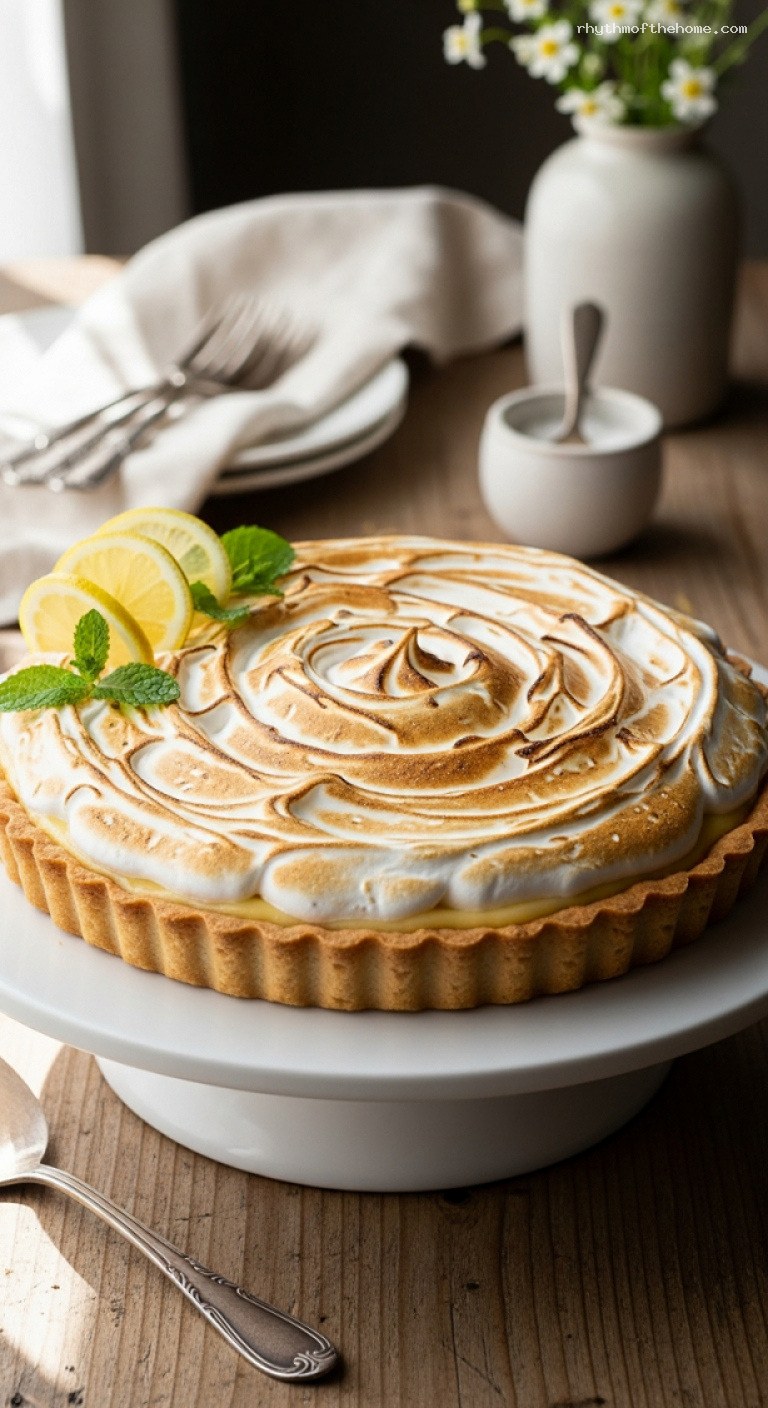
Quick Recipe Version (TL;DR)
Quick Ingredients
- Tart shell: 1 1/4 cups (150 g) all-purpose flour, 1/2 cup (60 g) powdered sugar, 1/4 tsp fine salt, 1/2 cup (113 g) cold unsalted butter, 1 large egg yolk, 1–2 tbsp ice water, 1 tsp vanilla extract (optional)
- Lemon curd: 4 large egg yolks, 2 large whole eggs, 3/4 cup (150 g) granulated sugar, 1 tbsp finely grated lemon zest, 1/2 cup (120 ml) fresh lemon juice, 1/8 tsp fine salt, 4 tbsp (56 g) unsalted butter
- Swiss meringue: 4 large egg whites, 1 cup (200 g) granulated sugar, 1/4 tsp cream of tartar, pinch of fine salt, 1 tsp vanilla extract
Do This
- 1. Make tart dough: pulse flour, powdered sugar, and salt; cut in cold butter; mix in egg yolk, vanilla, and just enough ice water to form a dough. Press into a disk, wrap, and chill 30 minutes.
- 2. Roll dough to a 12-inch circle, fit into a 9-inch tart pan, dock with a fork, chill 15 minutes, then blind-bake at 375°F (190°C) with weights for 15 minutes, and 8–12 minutes more without weights until golden. Cool completely.
- 3. For lemon curd, whisk yolks, eggs, sugar, zest, lemon juice, and salt in a saucepan. Cook over medium-low heat, whisking constantly, until thickened and just bubbling (170–175°F / 77–80°C). Off heat, whisk in butter. Strain and pour into cooled shell. Chill at least 1–2 hours until set.
- 4. For Swiss meringue, whisk egg whites, sugar, cream of tartar, and salt over a simmering water bath until sugar dissolves and mixture reaches 160°F (71°C). Beat with a mixer until glossy, stiff peaks form. Beat in vanilla.
- 5. Spoon or pipe meringue over chilled lemon curd, sealing edges. Swirl peaks.
- 6. Broil on the top rack (about 6 inches / 15 cm from heat) for 1–3 minutes until meringue is evenly toasted, watching constantly.
- 7. Cool 15–30 minutes to let layers settle, then slice with a clean, sharp knife and serve.
Why You’ll Love This Recipe
- Light but satisfying: a crisp, buttery tart shell with a bright, silky lemon curd and cloud-like Swiss meringue.
- Swiss meringue is smooth, glossy, and more stable than classic French meringue, so it holds its shape beautifully.
- The lemon curd is tart and vibrant without being harsh, thanks to a balanced sugar-to-lemon ratio.
- Perfect make-ahead dessert: you can prepare the shell and curd in advance and top with meringue just before serving.
Grocery List
- Produce: 3–4 fresh lemons (for juice and zest)
- Dairy: Unsalted butter, 7 large eggs (4 yolks + 2 whole eggs + 4 whites, with some overlap if you separate carefully)
- Pantry: All-purpose flour, powdered (confectioners’) sugar, granulated sugar, fine salt, vanilla extract, cream of tartar (optional but recommended)
Full Ingredients
Buttery Tart Shell
- 1 1/4 cups (150 g) all-purpose flour
- 1/2 cup (60 g) powdered (confectioners’) sugar
- 1/4 teaspoon fine salt
- 1/2 cup (113 g) unsalted butter, cold and cut into small cubes
- 1 large egg yolk
- 1–2 tablespoons ice water, as needed
- 1 teaspoon vanilla extract (optional, for flavor)
Silky Lemon Curd Filling
- 4 large egg yolks
- 2 large whole eggs
- 3/4 cup (150 g) granulated sugar
- 1 tablespoon finely grated lemon zest (from about 1–2 lemons)
- 1/2 cup (120 ml) freshly squeezed lemon juice (from about 3 lemons)
- 1/8 teaspoon fine salt
- 4 tablespoons (56 g) unsalted butter, cut into small pieces
Billowy Swiss Meringue Topping
- 4 large egg whites (about 120 g), at room temperature if possible
- 1 cup (200 g) granulated sugar
- 1/4 teaspoon cream of tartar (helps stabilize the meringue)
- Pinch of fine salt
- 1 teaspoon vanilla extract
Optional Garnish
- Very thin slices of lemon or small lemon twists
- Finely grated lemon zest
- Fresh mint leaves
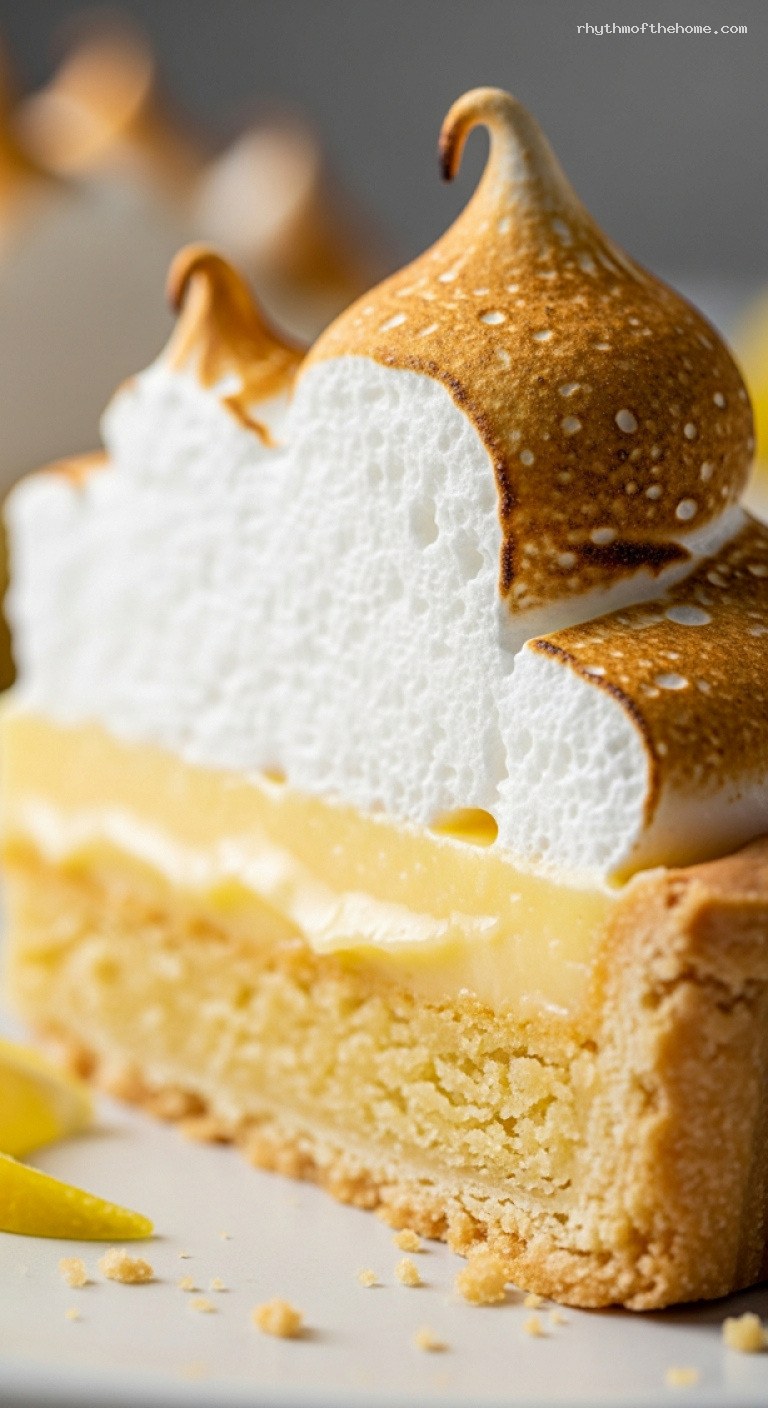
Step-by-Step Instructions
Step 1: Make the tart dough
In a medium bowl (or food processor), combine the flour, powdered sugar, and salt. Whisk or pulse to blend. Add the cold, cubed butter. If working by hand, use a pastry cutter or your fingertips to rub the butter into the dry ingredients until the mixture looks like coarse crumbs with some pea-sized bits of butter remaining. If using a food processor, pulse in short bursts until you get the same texture.
Add the egg yolk and vanilla (if using). Stir or pulse just until combined. Drizzle in 1 tablespoon of ice water and mix gently; if the dough looks very dry and sandy, add up to 1 more tablespoon of ice water, a little at a time, just until the dough starts to clump and holds together when pressed. Avoid overworking the dough.
Turn the dough out onto a piece of plastic wrap. Press it into a flat disk about 1 inch (2.5 cm) thick, wrap tightly, and refrigerate for at least 30 minutes (and up to 24 hours). Chilling relaxes the gluten and keeps the crust tender and easy to roll.
Step 2: Roll, line, and blind-bake the tart shell
Preheat your oven to 375°F (190°C). Lightly butter a 9-inch (23-cm) tart pan with a removable bottom or a 9-inch pie plate. On a lightly floured surface, roll the chilled dough into a roughly 12-inch (30-cm) circle, turning the dough and dusting with flour as needed to prevent sticking.
Gently lift the dough (you can roll it loosely around your rolling pin) and lay it into the tart pan. Ease it into the corners without stretching, then press the dough firmly into the sides. Trim excess by rolling the pin over the top edge or by cutting with a sharp knife. Patch any cracks with dough scraps.
Prick the base of the crust all over with a fork (this helps prevent bubbling). Place the lined pan in the refrigerator or freezer for 15 minutes to firm up. Meanwhile, cut a large piece of parchment paper or foil. Line the chilled crust with the parchment, then fill with pie weights, dried beans, or uncooked rice, pressing them gently into the corners.
Bake on the middle rack for 15 minutes. Carefully lift out the parchment with the weights. Return the shell to the oven and bake for another 8–12 minutes, until the crust is dry and golden around the edges and lightly golden on the base. If any bubbles appear, gently press them down with the back of a spoon. Let the baked shell cool completely on a wire rack while you make the lemon curd.
Step 3: Cook the silky lemon curd
In a medium, nonreactive saucepan (stainless steel or enamel), whisk together the egg yolks, whole eggs, sugar, lemon zest, lemon juice, and salt until smooth and fully combined. Place the pan over medium-low heat.
Cook, whisking constantly, until the mixture thickens and just begins to bubble around the edges, 8–12 minutes. It should coat the back of a spoon; if you run your finger through it, it should leave a clear trail. For the most precise results, cook until the curd reaches 170–175°F (77–80°C) on an instant-read thermometer. Do not let it boil vigorously or you risk scrambling the eggs.
Remove the pan from the heat and immediately whisk in the butter, a few pieces at a time, until completely melted and the curd is glossy and smooth. For an extra-silky texture, pour the hot curd through a fine-mesh sieve into a clean bowl, pressing with a spatula to remove any bits of zest or cooked egg.
Step 4: Fill the shell and chill the lemon layer
Once the tart shell has cooled to room temperature, pour the warm lemon curd into it. Use a spatula or the back of a spoon to spread the curd into an even layer, smoothing the surface.
Place the filled tart on a level shelf in the refrigerator. Chill for at least 1–2 hours, or until the lemon curd is fully set and no longer jiggly in the center. This chilling time helps the curd slice cleanly and keeps the meringue from sinking into the filling later.
Step 5: Make the Swiss meringue
When you are ready to top the tart, make the Swiss meringue. Fill a small saucepan with about 1 inch (2.5 cm) of water and bring it to a gentle simmer. In a clean, heatproof bowl (glass or stainless steel) that will fit snugly over the pan without touching the water, combine the egg whites, sugar, cream of tartar, and a pinch of salt. Place the bowl over the simmering water to create a double boiler.
Whisk constantly until the sugar dissolves completely and the mixture is warm and slightly foamy, 3–5 minutes. To be safe, continue heating and whisking until the mixture reaches 160°F (71°C). You can test for dissolved sugar by rubbing a little between your fingers; it should feel completely smooth, not gritty.
Remove the bowl from the heat. Using a stand mixer with the whisk attachment or a hand mixer, beat the warm mixture on medium-high speed until it becomes thick, glossy, and holds stiff peaks, 5–8 minutes. The bowl should feel cool to the touch. Beat in the vanilla during the last 30 seconds. You now have a stable, billowy Swiss meringue ready for topping.
Step 6: Crown the tart and toast under the broiler
Preheat your oven’s broiler on high and position a rack so that the top of the tart will be about 6 inches (15 cm) from the heat source. Make sure your lemon layer is well-chilled and firm.
Spoon generous mounds of meringue over the chilled lemon curd, spreading it all the way to the crust to seal the edges completely. This seal helps prevent the meringue from shrinking and keeps the curd from weeping. Use the back of a spoon or an offset spatula to create swirls, peaks, and decorative swoops—the more texture you create, the prettier the toasting will be.
Place the tart on a baking sheet for easy handling. Slide it under the broiler and toast for 1–3 minutes, watching constantly and rotating the tart as needed for even browning. The meringue should develop golden-brown peaks with some lighter and darker spots for a dramatic effect. Remove immediately once it is nicely browned; meringue goes from perfect to burnt very quickly under the broiler.
Step 7: Let it settle, garnish, and serve
Allow the tart to sit at room temperature for 15–30 minutes so the layers can relax and the meringue surface can dry slightly. If you like, garnish with very thin lemon slices, small twists of lemon peel, a sprinkle of extra zest, or a few tiny mint leaves for a fresh touch.
To slice cleanly, use a sharp knife dipped in hot water and wiped dry between cuts. Lift out slices with a pie server, trying to support both crust and filling. Serve the tart slightly cool or at room temperature for the best texture and flavor.
Pro Tips
- Keep the crust tender: Use cold butter and handle the dough as little as possible. Overworking develops gluten, which makes the crust tough instead of crisp and delicate.
- Cook the curd gently: Constant whisking over medium-low heat prevents scrambled eggs and keeps the curd ultra-smooth. If you see any tiny lumps, straining through a fine-mesh sieve works wonders.
- Meringue that does not weep: Heating the whites and sugar to 160°F (71°C) for Swiss meringue helps dissolve the sugar completely and makes a stable, less-weepy topping compared with classic French meringue.
- Seal the edges: Always spread meringue all the way to the crust. Any gaps between curd and meringue invite moisture and shrinkage.
- Watch the broiler like a hawk: Broilers vary wildly in power. Do not walk away—rotate the tart as needed and pull it the moment the meringue is evenly bronzed.
Variations
- Extra-light citrus blend: Replace 2–3 tablespoons of the lemon juice with freshly squeezed orange or Meyer lemon juice for a slightly sweeter, more floral curd.
- Graham nut crust: Swap the tart shell for a graham cracker crust made with 1 1/2 cups crushed graham crackers and 5 tablespoons butter; add 1/4 cup finely chopped toasted almonds or hazelnuts for a nutty twist.
- Torch instead of broiler: If you have a kitchen torch, skip the broiler and toast the meringue directly on the counter, moving the flame constantly for precise color and caramelization.
Storage & Make-Ahead
The tart shell can be made up to 2 days ahead. Blind-bake, cool completely, then wrap tightly and store at room temperature. The lemon curd can be prepared up to 2 days in advance as well; store it in an airtight container in the refrigerator, pressing plastic wrap directly onto the surface to prevent a skin from forming. You can fill the tart shell with curd up to a day ahead and keep it covered and refrigerated.
For best texture, the Swiss meringue topping is ideally made the day you plan to serve the tart. Once topped and toasted, the tart can be refrigerated, loosely covered, for up to 24 hours. The meringue may lose a bit of its outer crispness but will remain soft and marshmallowy inside. Leftover slices keep in the refrigerator for 2–3 days; store in a covered container and avoid stacking slices. This dessert is not well-suited to freezing, as the texture of both curd and meringue can suffer once thawed.
Nutrition (per serving)
Approximate values for 1 of 8 servings: about 440 calories; 23 g fat; 14 g saturated fat; 53 g carbohydrates; 1 g fiber; 39 g sugars; 7 g protein; 160 mg sodium. These numbers are estimates and will vary based on exact ingredients and portion sizes.

Leave a Reply