
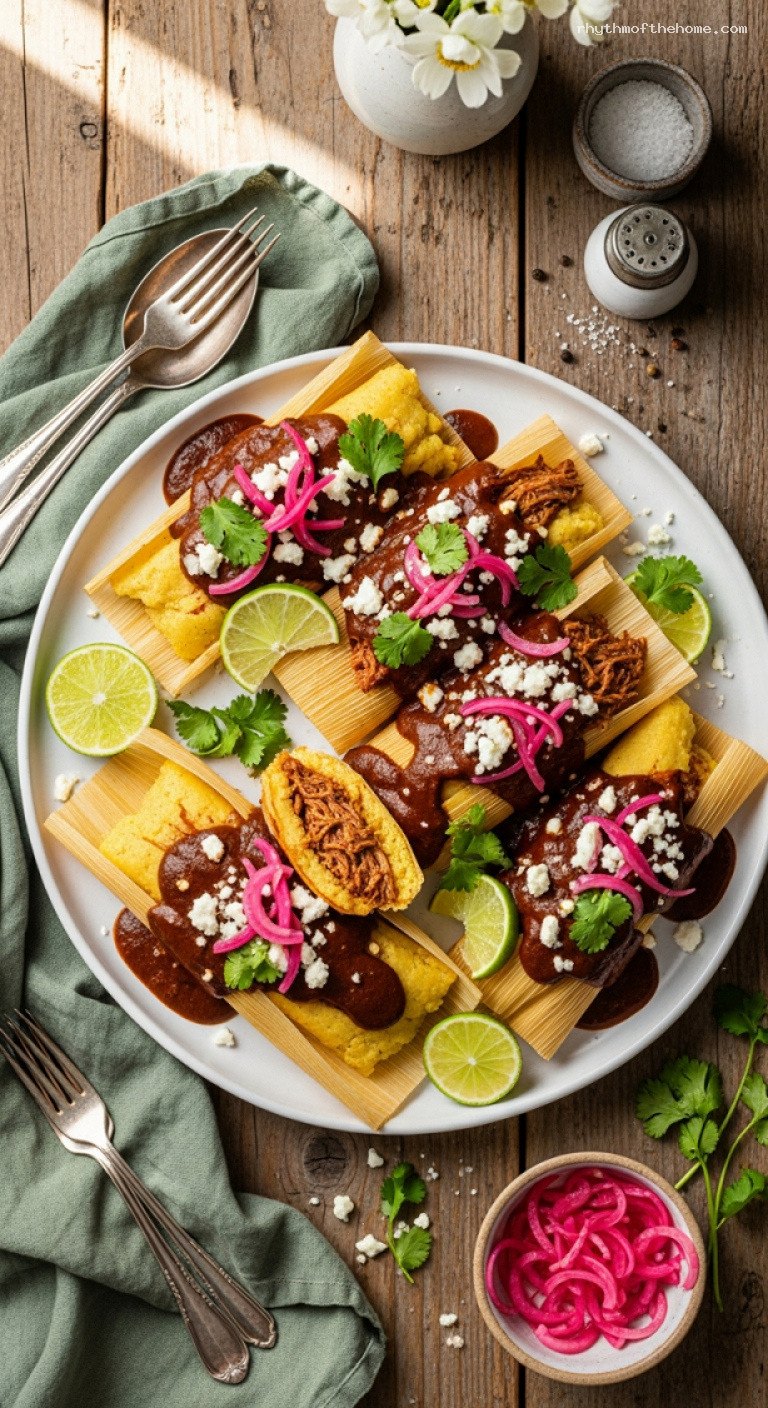
Holiday Pork Mole Tamales with Quick Pickled Onions and Queso
Quick Recipe Version (TL;DR)
Quick Ingredients
- 3 lb boneless pork shoulder, cut into large chunks
- 2 1/2 tsp kosher salt, 1 tsp black pepper, 1 tsp ground cumin, 1 tsp dried oregano, 2 bay leaves
- 3 1/2 cups low-sodium chicken broth (divided) + 1 tbsp vegetable oil
- 4 dried ancho chiles, 1 canned chipotle in adobo + 1 tbsp adobo sauce
- 1 small white onion (divided) + 5 garlic cloves (divided)
- 1/4 cup sliced almonds, 2 tbsp raisins, 1 tbsp sesame seeds, 1 small corn tortilla (torn), 1 tbsp brown sugar
- 1 1/2 oz Mexican chocolate (chopped) + 1 tbsp unsweetened cocoa powder
- 4 cups masa harina for tamales, 1 1/4 cups lard or vegetable shortening, 2 tsp baking powder
- 30–35 dried corn husks
- 1 large red onion, 1/2 cup apple cider vinegar, 1/2 cup water, 2 tbsp sugar, 1 1/2 tsp kosher salt
- 4 oz queso fresco (crumbled), fresh cilantro, lime wedges (for serving)
Do This
- 1. Brown seasoned pork in oil, add onion, garlic, spices, and 2 cups broth; cover and braise at 300°F (150°C) for about 2 1/2 hours until very tender.
- 2. Shred pork, skim and reserve about 2 cups cooking liquid. Toast and soak anchos, then blend with almonds, raisins, tortilla, chipotle, chocolate, cocoa, spices, and broth; simmer to make a thick mole and toss with shredded pork.
- 3. Make quick pickled onions: simmer vinegar, water, sugar, and salt; pour over sliced red onion with a little garlic and oregano; cool 30 minutes.
- 4. Whip lard until fluffy, then beat in masa harina, baking powder, salt, and enough warm broth to make a soft, spreadable dough.
- 5. Soak corn husks in very hot water until pliable (45–60 minutes); drain and pat dry.
- 6. Spread masa on husks, add a strip of pork mole, then fold and roll into tamales.
- 7. Steam tamales upright over gently simmering water for 60–75 minutes until the masa pulls cleanly from the husk; rest 10 minutes, then serve with pickled onions, queso, cilantro, and lime.
Why You’ll Love This Recipe
- Deep, cozy flavors from slow-braised pork and a smoky ancho-chile and chocolate mole.
- Fluffy, tender masa with the perfect balance of richness and corn flavor.
- Bright, tangy quick-pickled red onions and crumbly queso cut through the richness beautifully.
- Perfect for holidays and special gatherings, with lots of make-ahead options.
Grocery List
- Produce: 1 small white onion, 1 large red onion, 6–7 garlic cloves, fresh cilantro, limes (for serving)
- Dairy: 4 oz queso fresco (or more, to taste)
- Pantry: Boneless pork shoulder, dried corn husks, masa harina for tamales, dried ancho chiles, canned chipotle in adobo, low-sodium chicken broth, Mexican chocolate, unsweetened cocoa powder, sliced almonds, raisins, sesame seeds, small corn tortilla, apple cider vinegar, granulated sugar, brown sugar, kosher salt, black pepper, ground cumin, dried oregano, bay leaves, vegetable oil, baking powder
Full Ingredients
Braised Pork
- 3 lb boneless pork shoulder (pork butt), trimmed and cut into 2 to 3 inch chunks
- 1 1/2 tsp kosher salt
- 1 tsp freshly ground black pepper
- 1 tbsp vegetable oil
- 1 small white onion, quartered
- 3 garlic cloves, smashed
- 2 bay leaves
- 1 tsp ground cumin
- 1 tsp dried oregano (Mexican oregano if available)
- 2 cups low-sodium chicken broth
Smoky Ancho-Chile and Chocolate Mole
- 4 dried ancho chiles, stems and seeds removed
- 1 canned chipotle pepper in adobo, plus 1 tbsp adobo sauce
- 1/4 cup sliced almonds (or peanuts)
- 2 tbsp raisins
- 1 tbsp sesame seeds
- 1 small corn tortilla, torn into pieces (or 1 slice sturdy white bread)
- 2 garlic cloves
- 1/2 tsp ground cinnamon
- 1/8 tsp ground cloves (a small pinch)
- 1 1/2 oz Mexican chocolate, finely chopped
- 1 tbsp unsweetened cocoa powder
- 1 tbsp brown sugar (more to taste, if needed)
- 1 1/2 cups reserved pork cooking liquid or low-sodium chicken broth (plus more as needed to thin)
- 1 tbsp vegetable oil
- 1 tsp kosher salt, or to taste
Masa Dough
- 4 cups (about 480 g) masa harina specifically for tamales (not instant polenta or cornmeal)
- 2 tsp baking powder
- 2 tsp kosher salt
- 1 1/4 cups (about 250 g) lard or vegetable shortening, at room temperature
- 2 1/2 to 3 cups warm pork cooking liquid and/or low-sodium chicken broth (about 110°F / 43°C)
Corn Husks and Assembly
- 30–35 dried corn husks (to yield about 24 good husks, plus extras for lining and covering)
- Additional warm water for soaking husks
Quick Pickled Red Onions
- 1 large red onion, very thinly sliced (about 2 cups)
- 1/2 cup apple cider vinegar
- 1/2 cup water
- 2 tbsp granulated sugar
- 1 1/2 tsp kosher salt
- 1/2 tsp dried oregano (optional, Mexican oregano if available)
- 3–4 whole black peppercorns (optional)
- 1 small garlic clove, thinly sliced (optional)
For Serving
- 4 oz queso fresco, crumbled (about 1 cup loosely packed)
- Fresh cilantro leaves
- Lime wedges
Step-by-Step Instructions
Step 1: Brown the pork for deep flavor
Preheat your oven to 300°F (150°C). Pat the pork shoulder pieces very dry with paper towels so they brown well. Season them all over with the 1 1/2 tsp kosher salt and 1 tsp black pepper.
Heat 1 tbsp vegetable oil in a large, heavy Dutch oven (or oven-safe pot with a tight lid) over medium-high heat. When the oil is hot and shimmering, add about half the pork in a single layer. Brown for 3–4 minutes per side, turning with tongs, until nicely caramelized. Transfer browned pork to a plate and repeat with the remaining pork.
Reduce the heat to medium. Add the quartered white onion and smashed garlic cloves to the pot. Cook, stirring occasionally, for 2–3 minutes until lightly golden and fragrant, scraping up any browned bits from the bottom of the pot.
Step 2: Braise the pork until tender and shred
Return all browned pork and any accumulated juices to the pot with the onion and garlic. Add the bay leaves, ground cumin, dried oregano, and 2 cups of chicken broth. Stir well, scraping the bottom to release all the flavorful bits. Bring the mixture just up to a simmer over medium heat.
Cover the pot with a tight-fitting lid and transfer it to the preheated 300°F (150°C) oven. Braise for about 2 1/2 hours, or until the pork is very tender and easily shreds with a fork.
When done, carefully remove the pot from the oven. Transfer the pork pieces to a large bowl with a slotted spoon, discarding the bay leaves. Let cool slightly, then shred the pork with two forks into bite-sized shreds. Strain the braising liquid into a measuring cup or bowl, discarding solids. You should have about 2 to 2 1/2 cups; skim off excess fat and reserve this liquid for the mole and masa.
Step 3: Make the smoky ancho-chile and chocolate mole
While the pork braises (or afterwards if you prefer), make the mole. Heat a dry skillet over medium heat. Toast the dried ancho chiles for about 30 seconds per side, pressing them down with tongs just until fragrant and slightly pliable. Do not let them burn. Transfer to a heatproof bowl and cover with very hot water. Let soak for 20 minutes until softened, then drain and tear into pieces.
In the same dry skillet, toast the sliced almonds, sesame seeds, and torn corn tortilla pieces over medium heat for 3–4 minutes, stirring frequently, until lightly golden and fragrant. Transfer to a blender.
Add the softened ancho chiles, canned chipotle and adobo, raisins, garlic, cinnamon, cloves, Mexican chocolate, cocoa powder, brown sugar, and 1 cup of the reserved pork liquid (or chicken broth) to the blender. Blend until completely smooth, adding more liquid a splash at a time if needed to get a pourable consistency.
Heat 1 tbsp vegetable oil in a saucepan over medium heat. Carefully pour in the blended mole (it may sputter). Cook, stirring often, for 10–15 minutes, adding more reserved pork liquid as needed to reach a thick but spoonable sauce. Taste and season with about 1 tsp kosher salt (or to taste). You want a balance of smoky, slightly spicy, lightly sweet, and deeply savory.
Add the shredded pork to the pot with the mole and stir until every strand is coated. The mixture should be juicy but not soupy. If it seems dry, add a few tablespoons of reserved cooking liquid. Reduce heat to low, cover, and keep warm or reheat gently when ready to assemble.
Step 4: Prepare the quick-pickled red onions
Place the thinly sliced red onion in a heatproof bowl or jar. Add the dried oregano, black peppercorns, and sliced garlic, if using.
In a small saucepan, combine the apple cider vinegar, water, sugar, and kosher salt. Bring to a simmer over medium heat, stirring to dissolve the sugar and salt. As soon as it reaches a simmer and everything is dissolved, remove from heat.
Pour the hot pickling liquid over the onions, pressing them down gently so they are fully submerged. Let sit at room temperature for at least 30 minutes, stirring once or twice, until the onions turn bright pink and slightly softened. For best flavor, chill for 1–2 hours. These can be made up to 1 week ahead and stored in the refrigerator.
Step 5: Whip the masa dough and soak the husks
About 1 hour before you plan to assemble the tamales, place the dried corn husks in a large bowl or clean sink. Cover with very hot tap water. Weigh them down with a heavy plate so they stay submerged. Soak for 45–60 minutes, until soft and pliable. Drain well and gently pat dry before using.
Meanwhile, make the masa. In a large bowl (or the bowl of a stand mixer), whisk together the masa harina, baking powder, and 2 tsp kosher salt.
In another large bowl, beat the lard or shortening with a hand mixer (or in a stand mixer with the paddle attachment) on medium-high speed for 3–4 minutes, until very light and fluffy. This step helps create light, tender masa.
With the mixer on low, add the dry masa mixture in 2–3 additions, alternating with the warm pork liquid or broth. Start with 2 1/2 cups liquid, beating well after each addition, until the dough is soft, smooth, and spreadable, like thick peanut butter. If it feels stiff or crumbly, add more warm liquid 2 tbsp at a time. To test, drop a small piece of masa into a cup of cold water: if it floats or nearly floats, you are in good shape. Cover the masa with a damp towel to keep it from drying out.
Step 6: Set up your tamale assembly station
Drain the soaked corn husks and gently shake off excess water. Sort through and choose the largest, widest husks for filling. Tear a few of the smaller or torn husks into long strips; these can be used for tying tamales if desired or for lining the steamer.
Set up a comfortable assembly area: place the bowl of masa, the warm pork mole filling, the drained husks, and a spoon or small offset spatula within easy reach. If you are working alone, it helps to keep a damp kitchen towel over the husks you are not using so they stay flexible.
Have your steamer pot ready nearby. Add a couple of inches of water to the bottom (below the steaming rack) and line the rack with extra corn husks to prevent sticking. Do not turn on the heat yet; you will start the water once you have some tamales assembled.
Step 7: Fill, fold, and steam the tamales
To fill a tamale, lay one husk on your work surface with the narrow end pointing away from you and the smooth side facing up. Spoon about 1/4 cup of masa onto the center of the wide end. Using the back of a spoon or a small spatula, spread the masa into a rectangle about 4–5 inches long and 3 inches wide, leaving at least 1/2 inch border on the sides and 2 inches at the top (narrow) end.
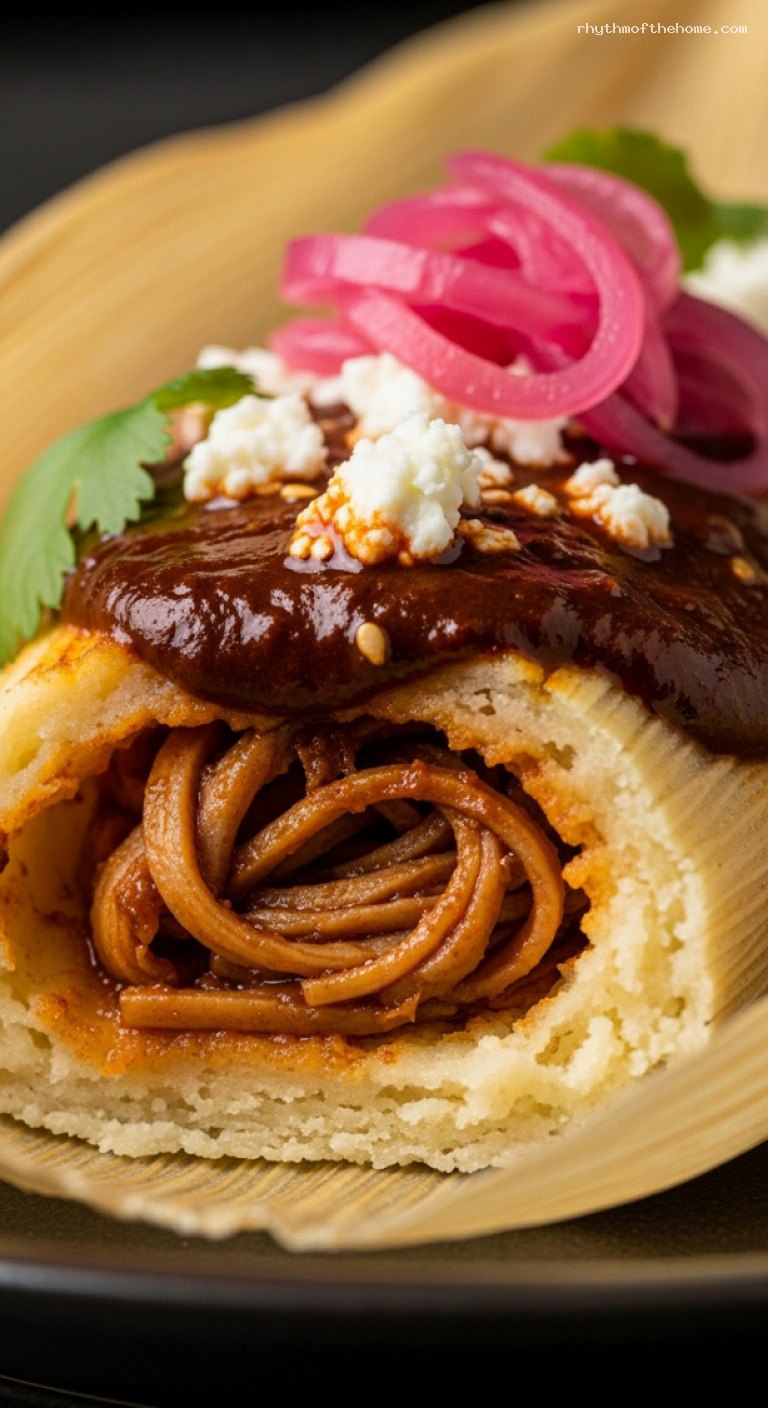
Place 2–3 tbsp of the pork mole filling in a line down the center of the masa. To fold, bring one long side of the husk across the filling, then bring the other side over to overlap, so the masa wraps around the filling. Fold the long seam to one side. Fold the narrow, pointed end of the husk up toward the filled section to make a neat little package. You can leave it as is or tie it with a husk strip. Repeat with remaining husks, masa, and filling. You should get about 24 tamales.
As you work, stand the tamales upright in the prepared steamer, open ends facing up. Once the steamer is filled, cover the top of the tamales loosely with extra corn husks or a clean kitchen towel, then place on a tight-fitting lid.
Bring the water in the steamer to a gentle simmer over medium heat. Steam the tamales for 60–75 minutes, checking occasionally to ensure there is always water in the bottom of the pot (add more hot water as needed). Avoid letting the water boil vigorously, which can make the tamales soggy.
To test for doneness, remove one tamale and let it rest for 5 minutes. Gently peel back the husk: if the masa pulls away cleanly and holds its shape, the tamales are done. If it still seems mushy or sticks heavily to the husk, steam for another 10–15 minutes and test again.
Step 8: Plate, garnish, and enjoy
Once done, turn off the heat and let the tamales rest in the steamer, covered, for 10 minutes. This helps the masa set fully and makes them easier to unwrap.
To serve, peel back the husks (or leave them partially on for a rustic presentation) and place 2–3 tamales on each plate. Spoon a little extra warmed mole over the top if you have some reserved. Generously top with quick-pickled red onions, a shower of crumbled queso fresco, and fresh cilantro leaves. Serve with lime wedges on the side for squeezing over just before eating.
Enjoy immediately while hot and tender, and watch them disappear at the table.
Pro Tips
- Use warm liquid for the masa. Warm pork cooking liquid or broth (about 110°F / 43°C) helps the fat blend smoothly into the masa and creates a lighter, fluffier dough.
- Do not skimp on whipping the fat. Beating the lard or shortening until very light and airy is key to tender tamales that are not dense or heavy.
- Keep everything moist. Cover the masa with a damp towel and keep husks wrapped or covered so nothing dries out while you assemble.
- Gentle steam, not a hard boil. Maintain a steady, gentle simmer under the tamales. Boiling can cause water to splash up and make the masa gummy.
- Make it a team project. Tamale assembly goes much faster and is more fun when two or three people form a little assembly line.
Variations
- Cheese and roasted poblano tamales: Replace the pork filling with strips of roasted poblano peppers and Oaxaca or Monterey Jack cheese. Keep the same masa and toppings.
- Spicier pork mole: Add an extra chipotle in adobo or a couple of dried guajillo chiles to the mole blend for more heat and a brighter chile flavor.
- Chicken mole tamales: Substitute boneless, skinless chicken thighs for the pork. Braise until tender, then shred and combine with the mole as directed.
Storage & Make-Ahead
These tamales are perfect for making ahead. The pork mole filling can be prepared up to 3 days in advance and stored in an airtight container in the refrigerator, or frozen for up to 2 months. The quick-pickled onions actually improve after a day in the fridge and keep well for about 1 week. You can mix the masa dough a day ahead; press a piece of plastic wrap directly on the surface and refrigerate, then bring to room temperature and re-whip briefly before using, adding a splash of warm broth if needed.
Cooked tamales keep in the refrigerator for up to 4 days. Reheat them by steaming over gently simmering water for 15–20 minutes, or in the microwave wrapped in a damp paper towel for 1–2 minutes per tamale. For longer storage, freeze fully cooled tamales (still in their husks) in a freezer bag or airtight container for up to 3 months. Reheat from frozen by steaming for 25–30 minutes, or microwave on medium power with a damp paper towel until heated through.
Nutrition (per serving)
Approximate values per serving (3 tamales with toppings): about 650 calories; 33 g total fat; 12 g saturated fat; 55–60 g carbohydrates; 6 g fiber; 10 g sugars; 28–30 g protein; 1,150 mg sodium. Actual values will vary based on the exact size of tamales, amount of filling and toppings, and specific ingredients used.

Leave a Reply