
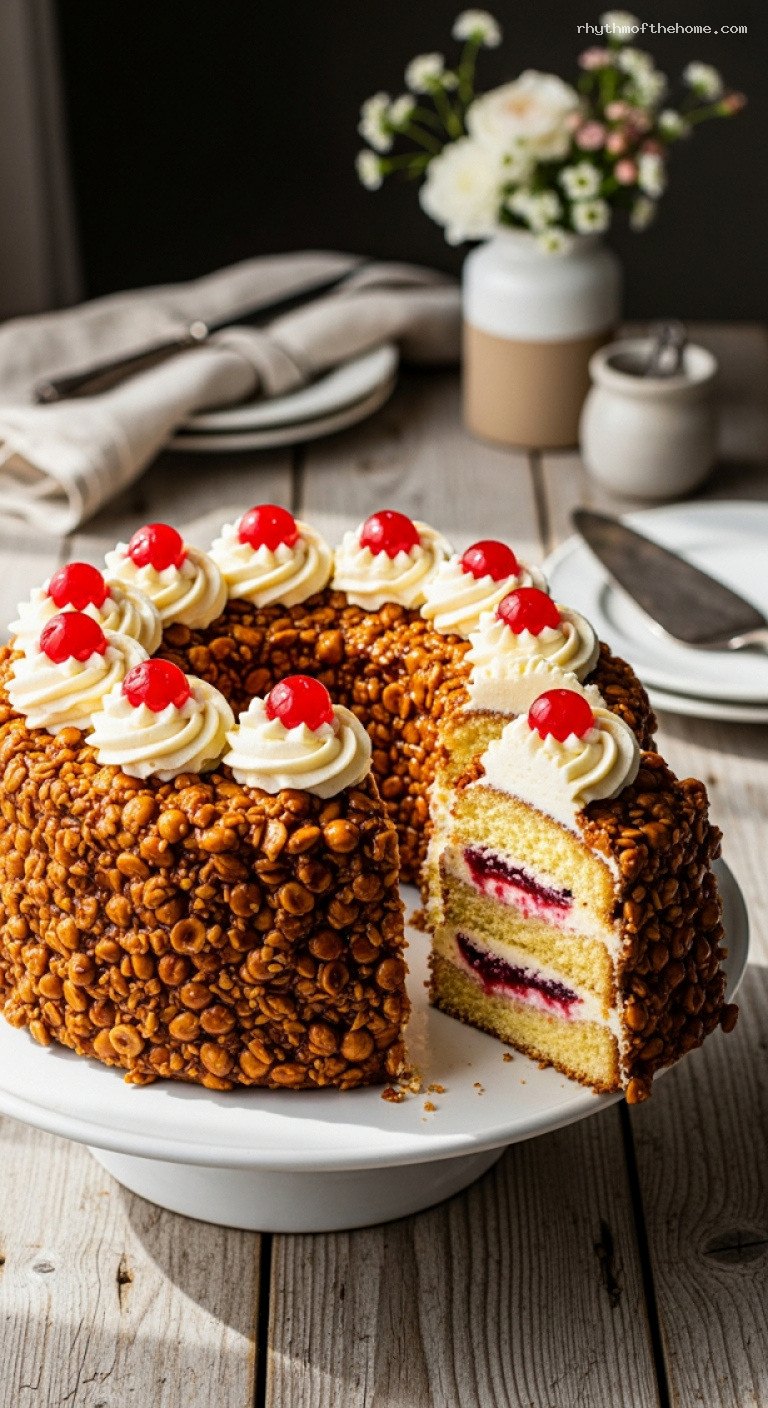
Quick Recipe Version (TL;DR)
Quick Ingredients
- 250 g unsalted butter, softened (for cake)
- 200 g granulated sugar + 250 g more for pastry cream and brittle
- 5 large eggs + 4 large egg yolks
- 280 g all-purpose flour + 100 g cornstarch
- 2 tsp baking powder, 1/4 tsp salt, vanilla, lemon zest
- 560 ml whole milk (for cake and pastry cream)
- 300 g very soft unsalted butter (for buttercream)
- 150 g finely chopped hazelnuts or almonds (for brittle)
- 180 g red currant jelly or seedless raspberry jam
- Candied cherries for decoration (optional)
Do This
- 1. Cook pastry cream with milk, yolks, sugar, and cornstarch until thick; cool completely.
- 2. Mix rich butter cake batter, bake in a well-greased ring/Bundt pan at 175°C / 350°F for 40–45 minutes; cool fully.
- 3. Cook sugar and water to a deep golden caramel, stir in chopped nuts, cool and finely chop to make brittle (Krokant).
- 4. Beat 300 g softened butter until fluffy, then slowly beat in the cooled pastry cream to make German buttercream.
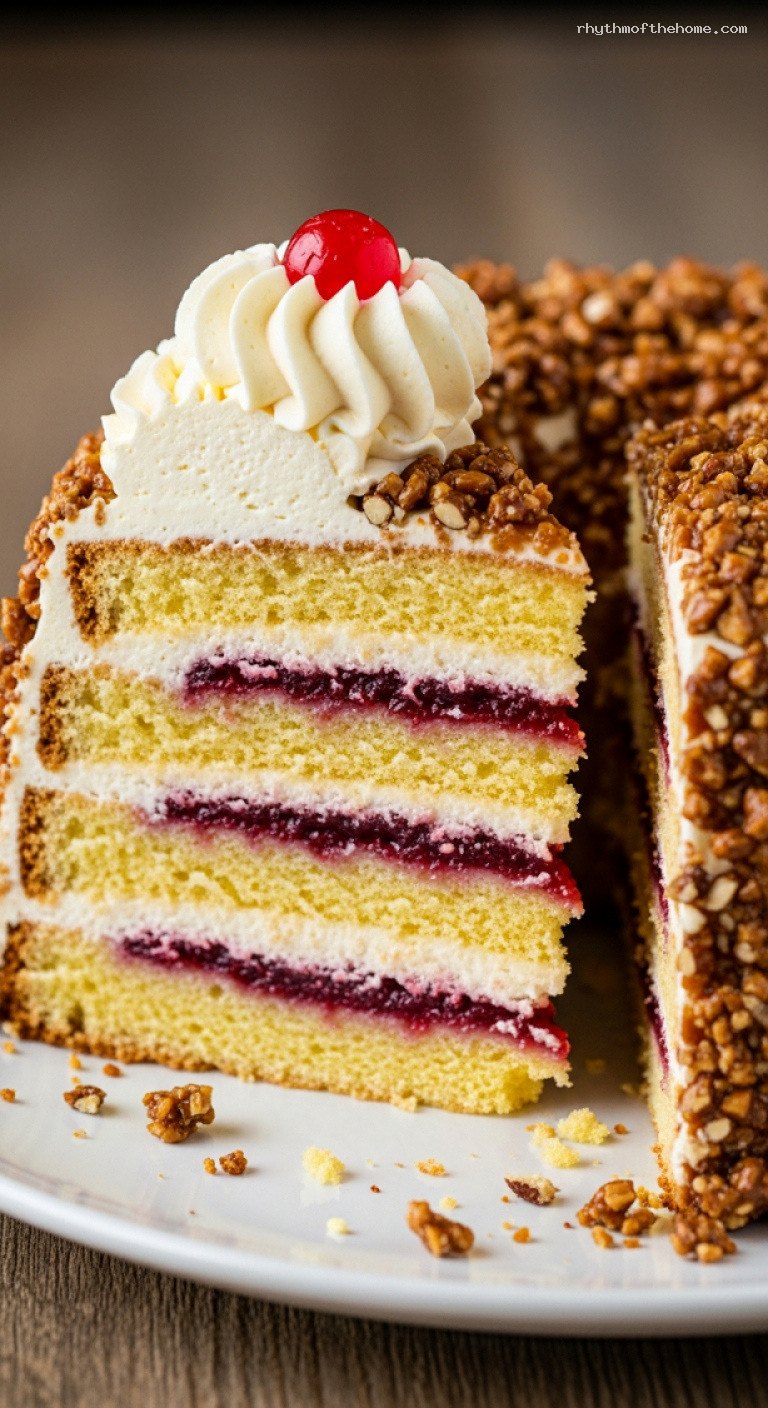
- 5. Slice the cake horizontally into 3 layers; spread jam then buttercream between each layer and re-stack.
- 6. Coat the outside of the ring with a generous layer of buttercream.
- 7. Press brittle all over the sides and top, then pipe buttercream rosettes and garnish with candied cherries.
Why You’ll Love This Recipe
- A true showstopper: a golden ring cake, silky buttercream, jewel-like jam, and a halo of crunchy caramelized brittle.
- Classic German bakery flavor at home: authentic German buttercream (not too sweet) with a tender, buttery crumb.
- Great for celebrations: birthdays, holidays, and special family gatherings where you want something impressive yet cozy.
- Make-ahead friendly: bake the cake, brittle, and pastry cream in advance, then assemble the day you serve.
Grocery List
- Produce: 1 lemon (for zest)
- Dairy: Unsalted butter (about 580 g total), whole milk (at least 600 ml), large eggs (9 total)
- Pantry: All-purpose flour, cornstarch, granulated sugar, fine salt, vanilla extract, red currant jelly or seedless raspberry jam, chopped hazelnuts or almonds, candied cherries or maraschino cherries (optional)
Full Ingredients
For the Ring Cake
- 250 g unsalted butter, softened (about 1 cup + 2 tablespoons)
- 200 g granulated sugar (about 1 cup)
- 1 teaspoon vanilla extract
- Finely grated zest of 1 small lemon (optional but traditional)
- 5 large eggs, at room temperature
- 220 g all-purpose flour (about 1 3/4 cups, spooned and leveled)
- 60 g cornstarch (about 1/2 cup)
- 2 teaspoons baking powder
- 1/4 teaspoon fine salt
- 60 ml whole milk, at room temperature (1/4 cup)
- Extra softened butter and flour or baking spray for greasing the ring/Bundt pan
For the Pastry Cream (Base of German Buttercream)
- 500 ml whole milk (2 cups)
- 100 g granulated sugar (1/2 cup)
- 40 g cornstarch (about 1/3 cup)
- 4 large egg yolks
- 1 teaspoon vanilla extract
- Pinch of fine salt
- 30 g unsalted butter (2 tablespoons), cut into small pieces
For the German Buttercream
- 300 g unsalted butter, very soft but not melted (about 1 1/3 cups)
- Cooled pastry cream from above (must be at room temperature)
For the Krokant (Nut Brittle Coating)
- 150 g granulated sugar (about 3/4 cup)
- 60 ml water (1/4 cup)
- 150 g finely chopped hazelnuts, almonds, or a mixture (about 1 1/4 cups)
- 10 g unsalted butter (about 2 teaspoons)
- Pinch of fine salt
For Filling & Decoration
- 180 g red currant jelly or seedless raspberry jam (about 1/2 cup + 2 tablespoons)
- 1–2 tablespoons water (to loosen jam, if needed)
- 8–10 candied cherries or maraschino cherries (for the top)
- Optional: a few fresh red currant sprigs for serving
Step-by-Step Instructions
Step 1: Make and Cool the Pastry Cream
Start with the pastry cream so it has time to cool. In a medium saucepan, heat the 500 ml milk over medium heat until steaming and just starting to bubble around the edges, but not boiling. Meanwhile, in a medium bowl, whisk together the 100 g sugar, 40 g cornstarch, 4 egg yolks, pinch of salt, and vanilla extract until smooth and pale.
Slowly pour about one-third of the hot milk into the yolk mixture while whisking constantly to temper the eggs. Pour this mixture back into the saucepan with the remaining milk, whisking well. Cook over medium heat, whisking constantly, until thick bubbles rise and the cream becomes very thick and glossy, 2–4 minutes. Remove from the heat and immediately whisk in the 30 g butter until melted and smooth.
Spread the cream into a shallow dish (this helps it cool faster). Press plastic wrap directly onto the surface to prevent a skin forming. Let cool to room temperature, then refrigerate until completely cold. Before using in the buttercream, it should be back to room temperature (not cold from the fridge) so it blends smoothly with the butter.
Step 2: Bake the Ring Cake
Preheat your oven to 175°C / 350°F (conventional, not fan). Generously grease a 24 cm / 10-inch ring or Bundt pan (about 2.4–2.8 liter capacity) with softened butter, taking care to get into all the crevices, then dust with flour and tap out the excess. This step is crucial for easy release.
In a large mixing bowl, beat the 250 g softened butter, 200 g sugar, vanilla extract, and lemon zest with an electric mixer on medium-high speed until very light and fluffy, 3–5 minutes. Beat in the 5 eggs one at a time, mixing well and scraping down the bowl after each addition; the mixture should stay smooth and creamy.
In a separate bowl, whisk together the 220 g flour, 60 g cornstarch, 2 teaspoons baking powder, and 1/4 teaspoon salt. On low speed, mix the dry ingredients into the butter mixture in two additions, alternating with the 60 ml milk. Mix just until combined and no dry streaks remain; do not overbeat.
Scrape the thick batter evenly into the prepared pan and smooth the top. Bake for 40–45 minutes, until the cake is golden, springs back lightly to the touch, and a skewer inserted into the thickest part comes out clean.
Cool the cake in the pan on a rack for 15 minutes, then carefully invert onto a wire rack. Remove the pan and let the cake cool completely, at least 1–1 1/2 hours. The cake must be fully cool before filling and frosting.
Step 3: Prepare the Krokant (Nut Brittle)
While the cake cools, make the brittle. Line a baking sheet with parchment paper or a silicone mat. In a medium, heavy-bottomed saucepan, combine the 150 g sugar and 60 ml water. Cook over medium heat, gently swirling the pan (do not stir) until the sugar dissolves and the syrup begins to bubble. Continue cooking, watching closely, until the syrup turns a deep golden amber, 7–10 minutes. If the edges brown faster, gently swirl to even the color.
As soon as the caramel reaches a rich amber color, remove from the heat and quickly stir in the chopped nuts, 10 g butter, and pinch of salt with a heatproof spatula. Work carefully; caramel is extremely hot. Immediately pour the mixture onto the prepared baking sheet and spread it out as evenly as possible.
Let the nut brittle cool completely until hard, about 20–30 minutes. Once cool, chop it finely with a sharp knife or pulse in a food processor to create small, crunchy pieces that will cling to the buttercream. Aim for pieces about the size of coarse breadcrumbs with a few larger shards for texture.
Step 4: Make the German Buttercream
When both the pastry cream and the 300 g butter are at room temperature (soft but not greasy or melted), you are ready to make the buttercream. If the pastry cream has been chilled, let it sit at room temperature and whisk it smooth before using.
In a large bowl, beat the 300 g softened butter with an electric mixer on medium-high speed until very light, fluffy, and pale, about 4–5 minutes. Gradually add the pastry cream, 1–2 tablespoons at a time, beating well after each addition. Scrape down the bowl several times. The mixture should come together into a smooth, silky buttercream. If it looks slightly curdled at any point, keep beating; it often smooths out as the temperatures equalize.
If your kitchen is warm and the buttercream feels too soft, chill it in the fridge for 10–15 minutes, then re-whip briefly. You want a consistency that is soft enough to spread and pipe, but firm enough to hold its shape on the cake.
Step 5: Slice and Fill the Cake Layers
Place the fully cooled ring cake on a cutting board. With a large serrated bread knife, carefully slice the cake horizontally into three even layers. It helps to mark the outside with toothpicks as a guide before cutting.
In a small bowl, stir the 180 g red currant jelly or raspberry jam with 1–2 tablespoons water if needed, just to loosen it into a spreadable consistency. Place the bottom layer of the cake on your serving plate or a cake board.
Spread a thin, even layer of jam over the bottom layer, going almost to the inner and outer edges. On top of the jam, spread or pipe a layer of buttercream (about 1/4–1/3 of the total), leaving a small margin at the edges to prevent it from squishing out too much. Gently place the middle cake layer on top.
Repeat with another layer of jam and buttercream, then top with the final cake layer, cut-side down for a neat surface. Press very gently to level the cake.
Step 6: Crumb-Coat and Chill the Cake
Using an offset spatula, spread a thin layer of buttercream over the top and sides of the cake to create a crumb coat. This first coat locks in crumbs and makes the final layer look smooth. Do not worry if it looks a bit patchy; you are just sealing the surface.
Place the cake in the refrigerator for about 20–30 minutes to let the crumb coat firm up. Meanwhile, keep the remaining buttercream at cool room temperature so it stays spreadable. If it firms up too much, briefly beat it again to restore its silky texture.
Step 7: Final Coat, Krokant, and Decoration
After chilling, apply a generous final layer of buttercream over the entire cake, smoothing the top and sides with an offset spatula. Aim for an even thickness so the Krokant adheres nicely.
Place the chopped nut brittle in a shallow bowl or on a tray. Working over the tray to catch any excess, gently press handfuls of brittle onto the sides of the cake, then onto the top, until the cake is completely encrusted in a golden, crunchy layer. Rotate the cake as you go, pressing the brittle firmly so it sticks to the buttercream.
If you like, reserve a small amount of plain buttercream before adding the Krokant. Transfer this to a piping bag fitted with a star tip and pipe rosettes evenly spaced around the top of the ring. Place a candied cherry on each rosette for the classic Frankfurter Kranz look. Chill the finished cake for at least 30–45 minutes to set, then let it sit at room temperature for about 20 minutes before slicing so the buttercream softens slightly.
Pro Tips
- Temperature is everything: For a silky German buttercream, the butter and pastry cream must be about the same (room) temperature. Too cold or too warm and the mixture can split.
- Grease the pan thoroughly: Ring and Bundt pans are detailed. Take your time to butter and flour every nook so the cake unmolds cleanly.
- Use a long serrated knife: When slicing the cake into layers, use gentle sawing motions and rotate the cake rather than trying to cut straight through in one go.
- Chill between stages: Short chilling periods after crumb-coating and after decorating help the cake set and make cleaner slices.
- Control the caramel color: The darker the caramel, the deeper and slightly more bitter the flavor. Aim for a rich amber rather than dark brown to keep the Krokant pleasantly nutty and sweet.
Variations
- Liqueur-kissed layers: Brush each cake layer lightly with Kirsch, rum, or a rum-sugar syrup before adding the jam and buttercream for a more festive, grown-up version.
- Lemon-berry Kranz: Add extra lemon zest to the cake and 1–2 teaspoons lemon juice to the buttercream, and use raspberry jam for a brighter, tangier flavor profile.
- Shortcut buttercream: If you prefer to skip pastry cream, make a simple buttercream by beating 300 g butter with 360 g powdered sugar, 1–2 tablespoons milk, and vanilla until fluffy. It will be sweeter and less traditional, but easier.
Storage & Make-Ahead
Frankfurter Kranz keeps well, making it ideal for entertaining. Store the finished cake, covered, in the refrigerator for up to 3 days. For the best texture and flavor, let slices sit at room temperature for about 20–30 minutes before serving so the buttercream softens and the flavors bloom.
You can prepare components ahead: bake the cake up to 2 days in advance, wrap tightly in plastic once fully cooled, and store at room temperature. The nut brittle can be made up to 3–4 days ahead and kept in an airtight container in a cool, dry place. The pastry cream can be made up to 1 day in advance and refrigerated; bring it back to room temperature before whipping into butter. Assembled cake is best within 24 hours for maximum crunch of the Krokant, as it slowly softens in the fridge.
Nutrition (per serving)
Approximate values per slice (1/12 of the cake): about 650–700 calories, 45–50 g carbohydrates, 45–50 g fat, 8–10 g protein, and 0.7–1.0 g sodium. These numbers are estimates and will vary based on the exact brands and nuts you use and how generously you apply buttercream and Krokant.

Leave a Reply