
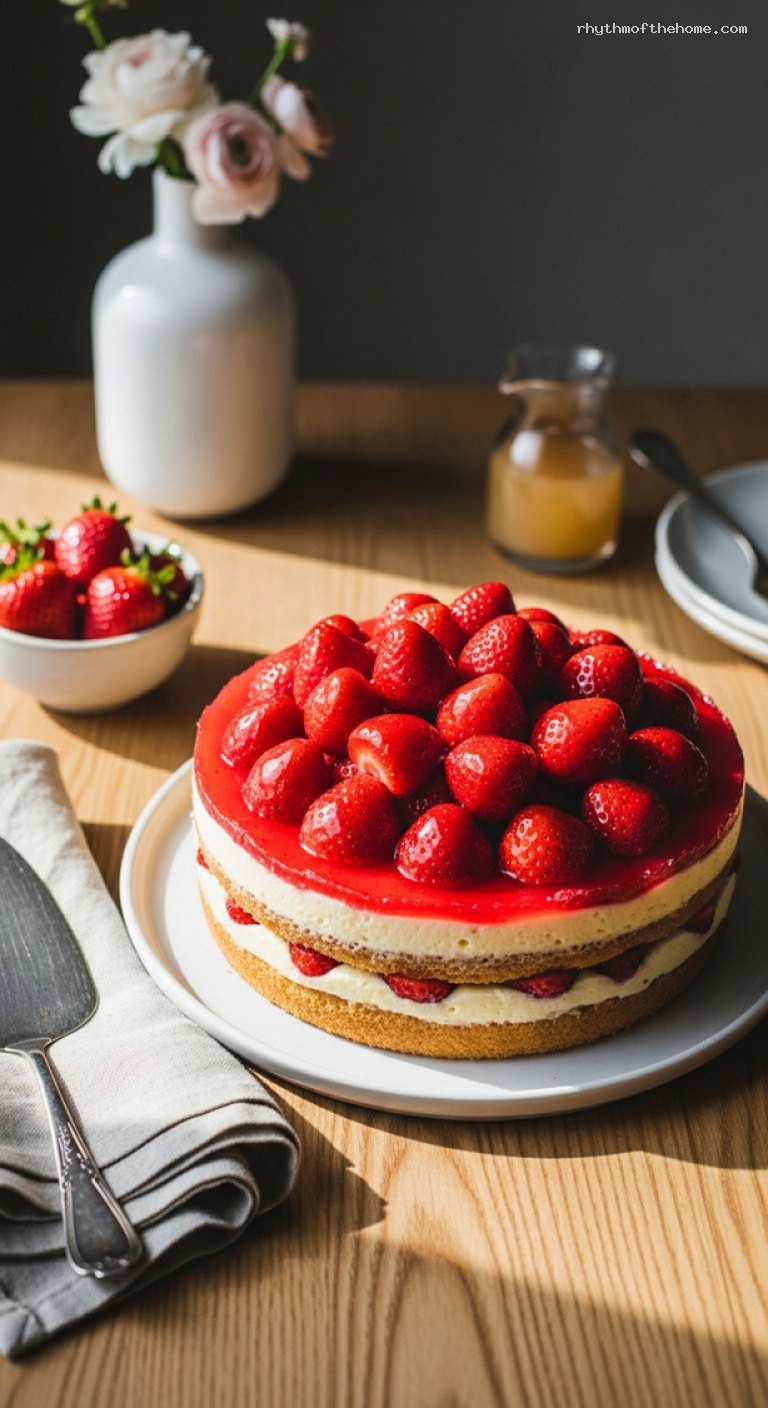
Quick Recipe Version (TL;DR)
Quick Ingredients
- 3 large eggs, room temperature
- 90 g sugar + pinch of salt
- 75 g all-purpose flour + 25 g cornstarch
- 1 tsp vanilla sugar or 1 tsp vanilla extract
- Butter and breadcrumbs for the pan
- 500 ml milk + 1 packet vanilla pudding powder (or 40 g cornstarch) + 40–60 g sugar
- 750 g fresh strawberries
- 1 packet red Tortenguss (cake glaze) + 250 ml apple juice or water + 2 tbsp sugar
- 2–3 tbsp apricot jam (optional, for extra shine)
Do This
- 1. Heat oven to 180°C / 350°F. Grease and breadcrumb a 26 cm tart or springform pan.
- 2. Whip eggs, sugar, vanilla, and salt until very thick and pale; gently fold in sifted flour + cornstarch.
- 3. Spread batter into pan and bake 15–18 minutes until golden; cool completely.
- 4. Cook vanilla pudding with milk and sugar; cover surface with plastic wrap and let cool until just lukewarm.
- 5. Hull and halve strawberries; pat dry.
- 6. Spread lukewarm pudding over sponge base, arrange strawberries tightly on top.
- 7. Cook Tortenguss with juice and sugar; spoon over berries, chill at least 1 hour until set.
Why You’ll Love This Recipe
- Classic German bakery flavor: soft, airy sponge, cool vanilla layer, and heaps of sweet fresh strawberries.
- Light but satisfying, perfect for warm-weather gatherings, birthdays, or Sunday coffee time.
- Make-ahead friendly: base and pudding can be prepared in advance for easy assembly.
- Flexible: delicious with or without pudding, and works beautifully with other summer fruits.
Grocery List
- Produce: 750 g fresh strawberries (about 1 ½–2 standard punnets)
- Dairy: 3 large eggs, 500 ml milk (whole or 2%), butter for greasing
- Pantry: sugar, vanilla sugar or vanilla extract, all-purpose flour, cornstarch or vanilla pudding powder, salt, red Tortenguss (cake glaze) powder, apple juice or water, apricot jam (optional), fine breadcrumbs (for pan)
Full Ingredients
For the Sponge Base (Biskuitboden)
- 3 large eggs, room temperature
- 90 g granulated sugar (about 7 tbsp)
- 1 tsp vanilla sugar or 1 tsp vanilla extract
- 1 small pinch fine salt
- 75 g all-purpose flour (about ⅝ cup), sifted
- 25 g cornstarch (about 3 tbsp), sifted
- Butter, for greasing the pan
- 1–2 tbsp fine breadcrumbs or flour, for dusting the pan
For the Vanilla Pudding Layer (Optional but Recommended)
- 500 ml milk (2 cups), preferably whole milk
- 1 packet vanilla pudding powder for cooking (about 37–40 g) or 40 g cornstarch (about 5 tbsp) plus 2 tsp vanilla extract
- 40–60 g sugar (3–5 tbsp), to taste
For the Strawberry Topping
- 750 g fresh ripe strawberries (about 1 ½–2 punnets)
- 2–3 tbsp apricot jam, warmed and strained (optional, for extra shine and flavor)
For the Glaze (Tortenguss)
- 1 packet red Tortenguss (clear red cake glaze powder, about 12 g)
- 250 ml clear apple juice or water (1 cup + 2 tbsp)
- 2 tbsp sugar
Step-by-Step Instructions
Step 1: Prepare the Pan and Preheat the Oven
Preheat your oven to 180°C / 350°F (top/bottom heat, not fan). Lightly butter the bottom and sides of a 26 cm round tart pan (with raised edge) or a 26 cm springform pan.
Sprinkle 1–2 tablespoons of fine breadcrumbs (or flour) into the pan and tilt it around so the bottom is evenly coated. Tap out any excess. This helps the delicate sponge release cleanly and stay slightly crisp on the edges.
Step 2: Whip the Eggs and Sugar Until Very Light
Place the eggs, sugar, vanilla sugar or extract, and pinch of salt into a large mixing bowl. Using a stand mixer with whisk attachment or a hand mixer, beat on high speed for 7–10 minutes until the mixture is very pale, thick, and voluminous.
You are aiming for a “ribbon stage”: when you lift the whisk, the batter should fall back in a thick ribbon that slowly dissolves into the surface. This trapped air is what makes the sponge light and fluffy, so take your time here.
Step 3: Fold in the Flour Mixture and Bake the Sponge
In a separate bowl, whisk together the flour and cornstarch. Sift this mixture over the whipped eggs in 2–3 additions.
Using a large spatula, gently fold the dry ingredients into the egg foam. Use light, sweeping motions from the bottom to the top, rotating the bowl as you go. Work slowly and stop as soon as no dry streaks remain; overmixing will deflate the batter.
Pour the batter into the prepared pan and gently smooth the surface. Bake in the preheated oven for 15–18 minutes until the top is light golden and springs back when lightly pressed in the center. A toothpick should come out clean.
Remove from the oven and let cool in the pan for about 10 minutes. Then carefully loosen the edges with a knife and turn the sponge out onto a wire rack. If you used a tart pan with raised edge, you can leave it in the pan to cool completely.
Step 4: Cook the Vanilla Pudding
While the sponge cools, prepare the vanilla pudding layer. In a small bowl, mix the pudding powder (or cornstarch) with a few tablespoons of the cold milk until smooth and lump-free.
In a saucepan, heat the remaining milk with the sugar over medium heat until it just starts to simmer. Whisk the starch mixture again, then pour it into the hot milk in a thin stream, whisking constantly.
Bring back to a gentle boil while whisking and cook for about 1 minute until thick and glossy. Remove from heat. If using plain cornstarch, stir in the vanilla extract now.
Pour the pudding into a clean bowl. Press a piece of plastic wrap directly onto the surface to prevent a skin forming. Let it cool until just lukewarm; it should still be spreadable but not hot, otherwise it can soak into and soften the sponge too much.
Step 5: Prepare the Strawberries
Rinse the strawberries briefly under cold water and drain well. Pat them dry gently with a clean kitchen towel or paper towel; excess water will dilute the glaze.
Hull the strawberries and cut them in halves or quarters, depending on their size. For a classic German bakery look, leave small berries whole and halve larger ones so you can stand them upright in neat circles on the cake.
Step 6: Assemble the Sponge, Pudding, and Strawberries
Place the cooled sponge base on a serving plate. If you turned it out of a flat springform pan, you can place a cake ring or the springform ring around it to help contain the pudding and glaze, though it is not strictly necessary if the pudding is firm.
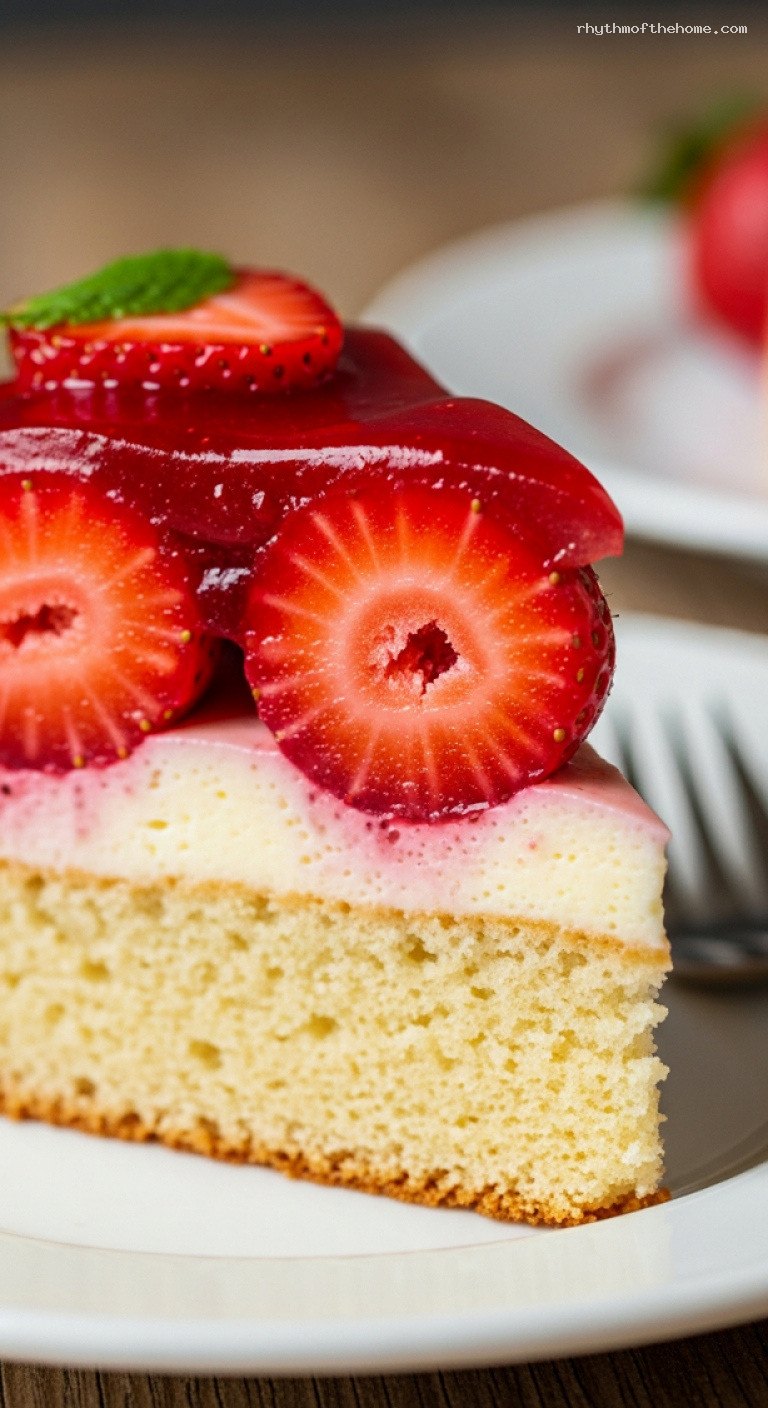
Stir the lukewarm pudding briefly to loosen it, then spread it evenly over the sponge, leaving a small margin (about 5 mm) at the edge. The layer should be about 0.5–1 cm thick.
Arrange the strawberries on top of the pudding, starting from the outer edge and working inward in circular rows. Pack them in fairly tightly so the surface is well covered.
If using apricot jam for extra shine, gently warm it until liquid, strain if needed, and lightly brush it over the strawberries before glazing.
Step 7: Prepare the Glaze and Finish the Cake
In a small saucepan, mix the Tortenguss powder with the sugar. Add a few tablespoons of the apple juice or water and stir until smooth. Then add the remaining liquid, whisking to combine.
Bring the mixture to a boil while stirring constantly. As soon as it boils and thickens slightly, remove it from the heat. Let it stand for 1–2 minutes, stirring occasionally, until it is no longer bubbling hot but still pourable.
Spoon or pour the glaze evenly over the strawberries, starting from the center and moving outward. Use a spoon to gently guide it so most berries are lightly coated. Work fairly quickly; Tortenguss sets fast.
Let the cake cool at room temperature for about 15 minutes, then refrigerate for at least 1 hour so the pudding and glaze can fully set before slicing.
Pro Tips
- Egg temperature matters: Room-temperature eggs whip up with more volume, giving you a higher, lighter sponge.
- Do not rush the whipping stage: Take the full 7–10 minutes to beat the eggs and sugar until thick and pale; this replaces baking powder in a classic Biskuit.
- Handle the batter gently: Fold in the flour and cornstarch with a light hand. If the batter deflates, the base will turn dense.
- Cool components properly: Sponge must be fully cool and pudding only lukewarm when assembling, or layers can slide or become soggy.
- Dry the berries well: Water on the strawberries prevents the glaze from clinging and can water down the pudding layer.
Variations
- Without pudding: Skip the vanilla pudding and spread a very thin layer of warmed apricot jam on the cooled sponge, then arrange strawberries and glaze. This gives a lighter, more minimalist Erdbeerkuchen.
- Cream cheese or mascarpone layer: Replace the pudding with a mixture of 250 g mascarpone or cream cheese, 200 ml whipped cream, 40–60 g sugar, and vanilla. Spread over the cooled sponge and top with strawberries and glaze.
- Mixed berry version: Combine strawberries with raspberries, red currants, or blueberries. Arrange them decoratively on the pudding and finish with clear or red glaze.
Storage & Make-Ahead
Store the finished Erdbeerkuchen covered in the refrigerator and enjoy within 1–2 days for best texture and freshness. The sponge base can be baked up to 1 day ahead; once cool, wrap it well in plastic wrap at room temperature.
You can also cook the pudding a few hours ahead. Keep it covered with plastic wrap directly on the surface and leave it at room temperature until lukewarm and spreadable, or gently re-whisk if it firms up too much. Assemble and glaze the cake at least 1 hour before serving so everything can set nicely.
Freezing is not recommended once the strawberries and glaze are added, as the fruit will lose its texture on thawing.
Nutrition (per serving)
Approximate values per slice (1 of 10): about 230 kcal, 4 g protein, 38 g carbohydrates, 6 g fat, 1 g fiber, 140 mg calcium. Values will vary slightly depending on the exact ingredients used and whether you include the pudding layer and apricot jam.

Leave a Reply