
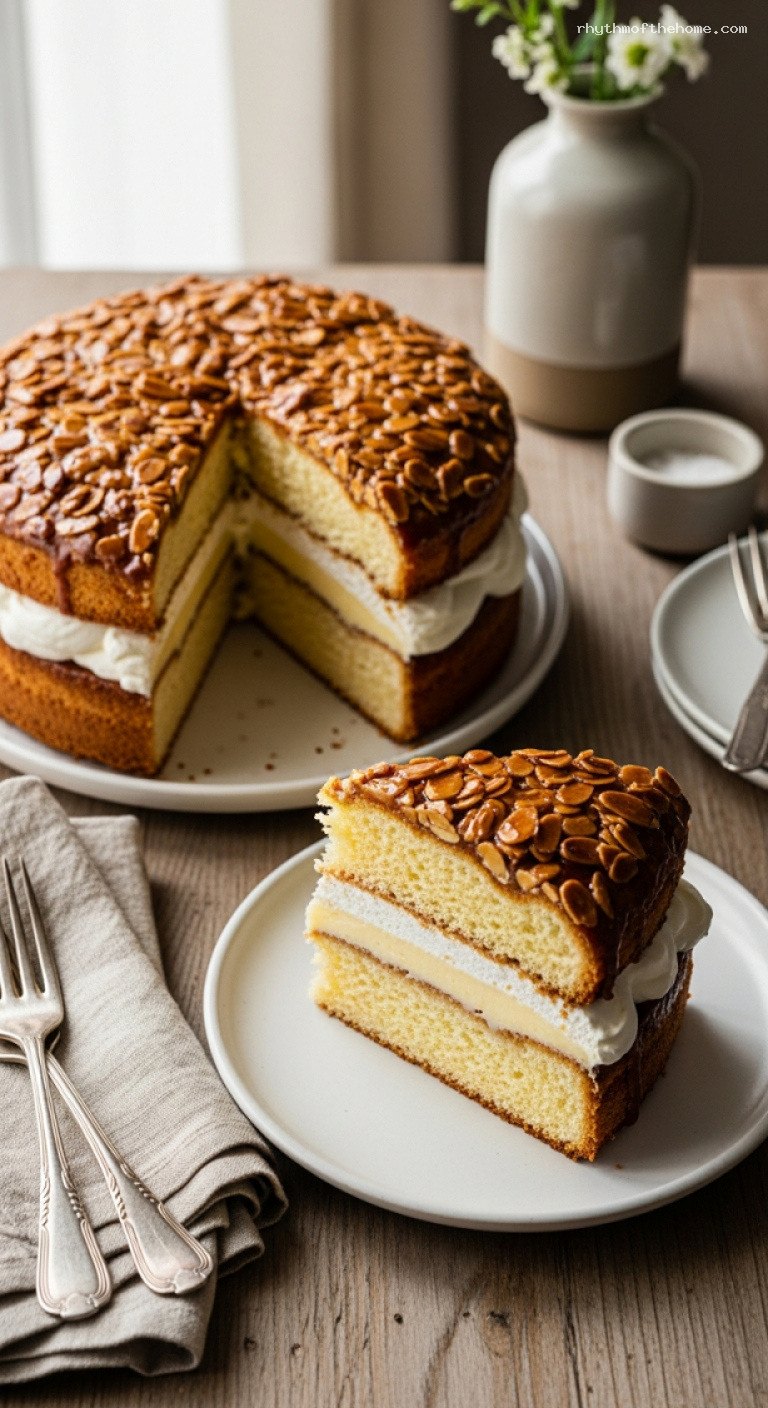
Quick Recipe Version (TL;DR)
Quick Ingredients
- Yeast cake: 240 ml warm whole milk; 7 g (2 1/4 tsp) instant or active dry yeast; 75 g (6 tbsp) sugar; 400 g (about 3 1/4 cups) all-purpose flour; 1/2 tsp fine salt; 1 large egg + 1 yolk; 70 g (5 tbsp) soft unsalted butter.
- Honey-almond topping: 75 g (5 tbsp) unsalted butter; 100 g (1/2 cup) sugar; 80 ml (1/3 cup) runny honey; 2 tbsp heavy cream; pinch salt; 1/2 tsp vanilla; 100 g (about 1 cup) sliced almonds.
- Vanilla custard: 500 ml (2 cups) whole milk; 150 g (3/4 cup) sugar; 4 large egg yolks; 30 g (1/4 cup) cornstarch; 1 tbsp flour; 1/4 tsp salt; 2 tsp vanilla extract or 1/2 vanilla bean; 30 g (2 tbsp) butter.
- To lighten custard: 240 ml (1 cup) cold heavy cream; 2 tbsp powdered sugar.
- Pan: Butter and parchment for a 23 cm / 9-inch springform pan.
Do This
- 1. Make custard: Heat milk with half the sugar and vanilla. Whisk yolks with remaining sugar, cornstarch, flour, and salt; temper with hot milk, cook until thick, whisk in butter, cover, and chill at least 2 hours.
- 2. Mix yeast dough: Bloom yeast in warm milk with sugar. Add egg, yolk, flour, salt, and soft butter; knead until smooth. Cover and let rise until doubled, 60–75 minutes.
- 3. Pan and rise: Pat dough into a greased, parchment-lined 9-inch springform pan. Let rise again 30–40 minutes until puffy.
- 4. Cook topping: Simmer butter, sugar, honey, and salt 3–4 minutes. Off heat, stir in cream, vanilla, and almonds; cool slightly.
- 5. Top and bake: Preheat oven to 175°C / 350°F. Gently spread almond-honey mixture over risen dough. Bake 22–28 minutes until deep golden and cooked through. Cool completely.
- 6. Slice: Carefully split the cooled cake horizontally into two layers; lift off the top almond-crusted layer.
- 7. Finish filling and assemble: Whip cream with powdered sugar and fold into chilled custard. Spread on bottom layer, replace top, chill 1 hour, then slice and serve.
Why You’ll Love This Recipe
- Classic German Bienenstich with a soft, slightly sweet yeasted cake and a shatteringly good honey-almond caramel crust.
- A luxurious vanilla custard filling, lightened with whipped cream for a cloud-like texture that contrasts beautifully with the chewy topping.
- Clear, step-by-step directions that walk you through the yeast dough, caramel topping, and custard without stress.
- Perfect for celebrations: looks bakery-fancy but is absolutely doable in a home kitchen.
Grocery List
- Produce: 1 lemon (optional, for zest in the filling or garnish).
- Dairy: Whole milk, unsalted butter, heavy cream, large eggs.
- Pantry: All-purpose flour, cornstarch, granulated sugar, powdered sugar, honey, sliced almonds, instant or active dry yeast, fine salt, vanilla extract or vanilla bean.
Full Ingredients
For the Vanilla Custard Filling
- 500 ml (2 cups) whole milk
- 150 g (3/4 cup) granulated sugar, divided
- 4 large egg yolks (cold or room temperature)
- 30 g (1/4 cup) cornstarch
- 8 g (1 tbsp) all-purpose flour (helps the custard set firmly)
- 1/4 tsp fine salt
- 2 tsp pure vanilla extract or seeds from 1/2 vanilla bean
- 30 g (2 tbsp) unsalted butter, cut into small pieces
- Finely grated zest of 1/2 lemon (optional, but lovely)
To Lighten the Custard (Diplomat-Style Cream)
- 240 ml (1 cup) cold heavy cream
- 2 tbsp powdered (confectioners’) sugar
For the Yeasted Cake Base
- 240 ml (1 cup) whole milk, warmed to 38–43°C / 100–110°F
- 7 g (2 1/4 tsp) instant or active dry yeast
- 75 g (6 tbsp) granulated sugar
- 400 g (about 3 1/4 cups) all-purpose flour, spooned and leveled
- 1/2 tsp fine salt
- 1 large egg, at room temperature
- 1 large egg yolk, at room temperature
- 70 g (5 tbsp) unsalted butter, very soft but not melted
For the Honey-Almond Topping
- 75 g (5 tbsp) unsalted butter
- 100 g (1/2 cup) granulated sugar
- 80 ml (1/3 cup) runny honey (a mild floral honey works nicely)
- Pinch of fine salt
- 2 tbsp heavy cream
- 1/2 tsp pure vanilla extract
- 100 g (about 1 cup) sliced almonds
For the Pan and Assembly
- Butter or nonstick spray, for greasing the pan
- Parchment paper (for the base of the pan)
- Optional: extra powdered sugar or a few lemon zest strands, for garnish
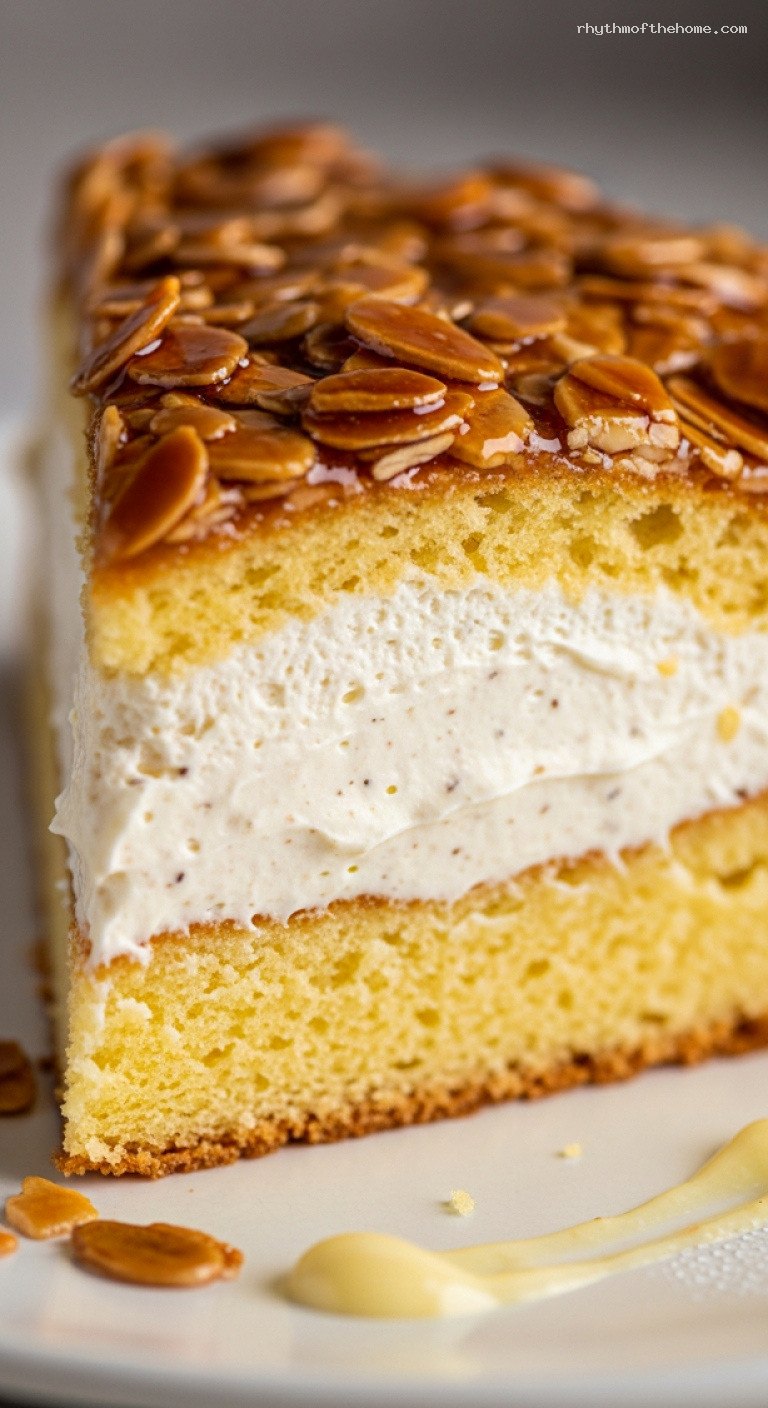
Step-by-Step Instructions
Step 1: Make the Vanilla Custard Base
Start with the custard so it has time to chill and set. In a medium saucepan, add the milk and about half of the sugar (75 g / a heaping 1/4 cup). If using a vanilla bean, split it lengthwise, scrape out the seeds, and add both seeds and pod to the milk. Warm over medium heat until steaming and just barely starting to bubble around the edges, then turn the heat to low.
Meanwhile, in a medium heatproof bowl, whisk together the egg yolks, remaining sugar, cornstarch, flour, and salt until smooth and pale. The mixture should be thick but lump-free. Slowly pour in about one-third of the hot milk while whisking constantly to temper the eggs. Pour this mixture back into the saucepan with the remaining milk, whisking all the time.
Cook over medium heat, whisking continuously, until the custard bubbles and thickens to a pudding-like consistency, 2–4 minutes after it comes to a simmer. Remove from heat, fish out the vanilla pod if used, and whisk in the butter, vanilla extract (if not using a pod), and optional lemon zest until glossy.
Pour the custard into a shallow dish, press plastic wrap directly onto the surface to prevent a skin, and refrigerate until completely cold and firm, at least 2 hours (and up to 2 days).
Step 2: Prepare the Yeasted Dough
In a large mixing bowl (or the bowl of a stand mixer), combine the warm milk, yeast, and sugar. Stir and let stand for 5–10 minutes, until the mixture looks foamy. (If it does not foam, your yeast may be inactive; start again with fresh yeast.)
Add the egg, egg yolk, flour, and salt. Mix with a wooden spoon or the dough hook on low speed until a shaggy dough forms. Add the soft butter a spoonful at a time, mixing or kneading until incorporated.
Knead the dough for 8–10 minutes by hand on a lightly floured surface (or 6–8 minutes on medium speed in a stand mixer) until it is smooth, elastic, and slightly tacky but not sticky. If it feels very sticky, add 1–2 tbsp more flour, just enough to handle.
Form the dough into a ball, place it in a lightly greased bowl, cover with a clean towel or plastic wrap, and let rise in a warm, draft-free spot until doubled in size, 60–75 minutes.
Step 3: Shape in the Pan and Let It Rise Again
Lightly grease a 23 cm / 9-inch springform pan and line the bottom with a circle of parchment paper. Once the dough has doubled, gently punch it down to release excess gas and turn it out onto a lightly floured surface.
Shape it into a smooth ball, then flatten into a thick disk. Transfer the disk to the prepared pan and use your fingertips to gently press it out to the edges in an even layer. Try to keep the thickness uniform so it bakes evenly.
Cover the pan loosely and let the dough rise again until puffy and slightly risen, 30–40 minutes. It will not necessarily double this time, but it should look lighter and airy.
Step 4: Cook the Honey-Almond Topping
While the dough is undergoing its second rise, make the topping. In a small to medium saucepan, combine the butter, sugar, honey, and a pinch of salt. Cook over medium heat, stirring frequently, until the mixture comes to a gentle simmer. Continue to simmer for 3–4 minutes, until slightly thickened and glossy.
Remove from the heat and carefully stir in the heavy cream and vanilla. The mixture may bubble up at first. Stir until smooth, then fold in the sliced almonds, coating them evenly.
Set the topping aside for 10–15 minutes to cool and thicken slightly. It should be spreadable rather than runny so it does not sink into the dough too much.
Step 5: Top the Cake and Bake
About 15 minutes before baking, preheat your oven to 175°C / 350°F. Place the springform pan on a baking sheet lined with foil or parchment to catch any drips.
Once the dough is puffy, gently spoon the honey-almond mixture over the surface, spreading it evenly all the way to the edges with an offset spatula or the back of a spoon. Try not to deflate the dough; work lightly.
Bake for 22–28 minutes, until the almond topping is a deep golden brown and the cake feels set in the center. The internal temperature of the cake should be around 93°C / 200°F, or a toothpick inserted into the cake (not the topping) should come out clean.
If the top is browning too quickly after about 15 minutes, loosely tent with foil and continue baking until done. Let the cake cool in the pan for 15 minutes, then carefully run a knife around the edge and remove the springform ring. Cool completely on a rack, at least 1 hour.
Step 6: Split the Cake into Two Layers
Once the cake is completely cool, it is time to turn it into a filled “sandwich.” For easiest slicing later, you can lightly mark the top almond layer into 12 wedges with a sharp knife before cutting horizontally.
Using a long serrated bread knife, carefully slice the cake in half horizontally. Go slowly, turning the cake as you cut and keeping the knife level so the layers are even. Gently lift off the almond-topped upper layer; you can use a large cake lifter or slide it onto a flat baking sheet or cardboard round. Set aside while you prepare the filling.
Step 7: Whip the Cream, Fold into Custard, and Assemble
Take the chilled custard from the refrigerator. It will be firm; whisk it briefly to smooth it out. In a separate bowl, whip the cold heavy cream with the powdered sugar to soft-medium peaks: it should hold its shape but still look silky.
Gently fold about one-third of the whipped cream into the custard to loosen it, then fold in the rest until fully combined and airy. You should have a thick but spreadable, mousse-like cream.
Place the plain bottom layer of the cake on your serving plate. Pile the custard cream in the center and spread it evenly to within about 1 cm (1/2 inch) of the edge; the top layer will push it outward a bit more. Carefully place the almond-topped layer back on top, lining up the edges. If you pre-scored wedges, use those markings when slicing later.
Refrigerate the assembled Bee Sting Cake for at least 1 hour before serving to allow the filling to firm up and the flavors to meld. Use a very sharp serrated knife and a gentle sawing motion to cut neat slices.
Pro Tips
- Chill the custard completely: Warm custard will not hold its shape when folded with whipped cream. Make it early in the day or the day before so it has plenty of time to cool.
- Do not rush the rises: Letting the yeast dough fully rise makes the cake light and tender. If your kitchen is cool, give it extra time or place the bowl in a slightly warm (but turned off) oven.
- Cool the topping slightly before using: If the honey-almond mixture is too hot and runny, it can sink into the dough and create dense patches instead of a nice crust.
- Score the top for easy slicing: Lightly marking the almond crust into wedges before splitting the cake and filling it makes serving much easier and helps prevent the topping from shattering.
- Adjust sweetness subtly: If you prefer a less sweet dessert, you can reduce the sugar in the topping by about 15–20 g (1–1 1/2 tbsp) without affecting texture too much.
Variations
- Traditional firmer pastry-cream filling: Skip the whipped cream and simply use the chilled custard on its own for a denser, more classic bakery-style filling that slices very cleanly.
- Citrus-honey Bee Sting Cake: Add 1–2 tsp of finely grated lemon or orange zest to the honey-almond topping and a little extra zest to the custard for a bright, fragrant twist.
- Rectangle or snack-sized portions: Bake the dough in a parchment-lined 20 x 30 cm (9 x 13 inch) pan, then cut the cooled cake into rectangles and split each one individually for little filled “Bee Sting” bars.
Storage & Make-Ahead
The filled cake should be stored in the refrigerator, covered, for up to 3 days. The honey-almond topping will soften slightly over time but the flavors remain wonderful. For the best texture, serve within 24 hours of assembling.
You can make the custard up to 2 days ahead; keep it refrigerated with plastic wrap pressed directly on the surface. Whip the cream and fold it in just before assembling. The yeasted cake base (without filling) can be baked, cooled, wrapped tightly, and stored at room temperature for 1 day or frozen for up to 1 month. Thaw at room temperature before slicing and filling. Avoid freezing the fully assembled cake, as the custard and whipped cream do not freeze and thaw well.
Nutrition (per serving)
Approximate values for 1 of 12 servings: about 480 calories; 25 g fat (14 g saturated); 55 g carbohydrates; 3 g fiber; 30 g sugars; 9 g protein; 230 mg sodium. These numbers are estimates and will vary with exact ingredients and portion sizes.

Leave a Reply