
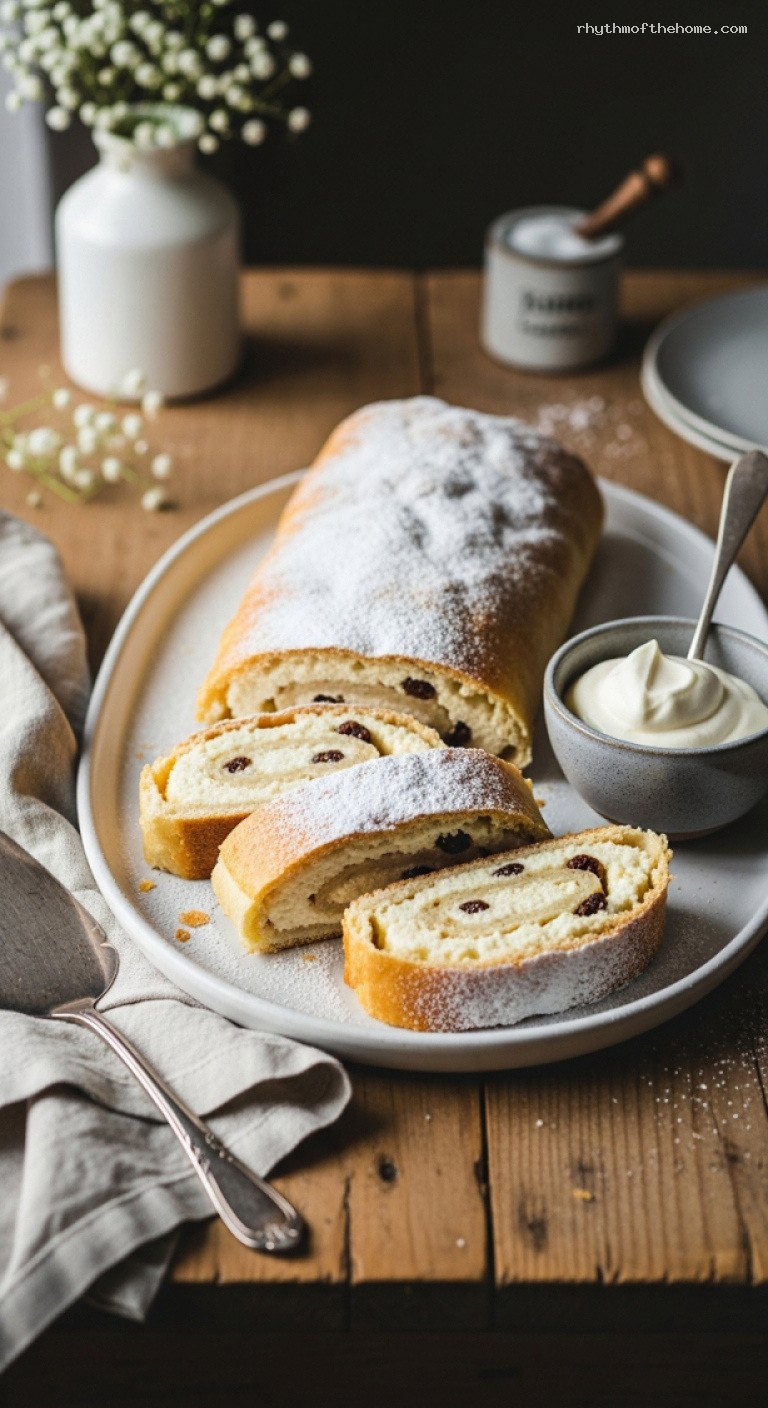
Quick Recipe Version (TL;DR)
Quick Ingredients
- 250 g (2 cups) all-purpose flour
- 1/2 tsp fine salt
- 150 ml (2/3 cup) lukewarm water
- 2 tbsp neutral oil, plus extra for bowl
- 1 tsp white vinegar
- 90 g (6 tbsp) unsalted butter, melted (for dough and brushing)
- 40 g (1/3 cup) fine dry breadcrumbs
- 500 g quark or well-drained whole-milk ricotta
- 100 g (1/2 cup) granulated sugar
- 1 packet (8 g) vanilla sugar or 2 tsp vanilla extract
- 2 large eggs
- 60 g (1/4 cup) sour cream or crème fraîche
- 60 ml (1/4 cup) heavy cream or milk
- Zest of 1 lemon
- 30 g (1/4 cup) cornstarch or fine semolina
- 60 g (1/3 cup) raisins soaked in 2 tbsp rum or warm water (optional)
- Powdered sugar, for dusting
Do This
- 1. Stir flour and salt together, add lukewarm water, oil, and vinegar; knead 8–10 minutes until smooth and elastic. Coat lightly with oil, cover, and rest 45 minutes.
- 2. Soak raisins (if using). Toast breadcrumbs in 30 g (2 tbsp) melted butter until golden; cool.
- 3. For filling, beat quark, sugar, vanilla, egg yolks, sour cream, cream, lemon zest, cornstarch, and a pinch of salt until smooth. Whip egg whites to soft peaks and fold in with drained raisins.
- 4. Heat oven to 190°C / 375°F. Line a baking sheet with parchment. Melt remaining butter for brushing.
- 5. On a floured cloth, gently stretch rested dough from the center until paper-thin and translucent. Trim thick edges.
- 6. Brush dough with melted butter, sprinkle toasted breadcrumbs over the lower third, spread filling on top, then roll up using the cloth. Seal ends and place seam-side down on tray. Brush with more butter.
- 7. Bake 35–40 minutes until deep golden. Cool at least 15 minutes, dust with powdered sugar, slice, and serve warm or at room temperature.
Why You’ll Love This Recipe
- Lighter than classic apple strudel but still indulgent, with a creamy, tangy, cheesecake-like filling.
- Homemade stretched dough bakes up whisper-thin and crisp, yet the method is totally achievable for home cooks.
- Simple ingredients from the dairy aisle and pantry come together for a special-occasion-worthy dessert.
- Delicious served warm or at room temperature, with just powdered sugar or a spoonful of softly whipped cream.
Grocery List
- Produce: 1 lemon (for zest)
- Dairy: Quark or whole-milk ricotta, eggs, unsalted butter, sour cream or crème fraîche, heavy cream or milk
- Pantry: All-purpose flour, fine salt, neutral oil, white vinegar, granulated sugar, vanilla sugar or vanilla extract, cornstarch or fine semolina, fine dry breadcrumbs, raisins, rum (optional), powdered sugar
Full Ingredients
Strudel Dough
- 250 g (2 cups) all-purpose flour
- 1/2 tsp fine salt
- 150 ml (2/3 cup) lukewarm water
- 2 tbsp neutral oil (such as sunflower or canola), plus a little extra for coating the dough
- 1 tsp white vinegar or apple cider vinegar
- 60 g (4 tbsp) unsalted butter, melted (for brushing the dough and strudel before baking)
Breadcrumb Layer
- 40 g (1/3 cup) fine dry breadcrumbs
- 30 g (2 tbsp) unsalted butter
Creamy Quark Filling
- 500 g quark or farmer’s cheese
- If using ricotta instead of quark: choose whole-milk ricotta, drain in a fine sieve or cheesecloth for at least 1 hour to remove excess moisture, then measure 500 g drained ricotta.
- 100 g (1/2 cup) granulated sugar
- 1 packet (8 g) vanilla sugar or 2 tsp pure vanilla extract
- 2 large eggs, separated
- 60 g (1/4 cup) sour cream or crème fraîche
- 60 ml (1/4 cup) heavy cream or whole milk
- Finely grated zest of 1 untreated lemon (about 1 tsp, lightly packed)
- 30 g (1/4 cup) cornstarch or fine semolina
- Pinch of fine salt
- 60 g (1/3 cup) raisins, optional
- 2 tbsp dark rum or warm water, for soaking raisins
For Baking and Serving
- Additional melted butter from the 60 g above (or 1–2 extra tbsp if needed) for brushing during baking
- Powdered sugar, for dusting
- Softly whipped cream or vanilla sauce, optional, for serving
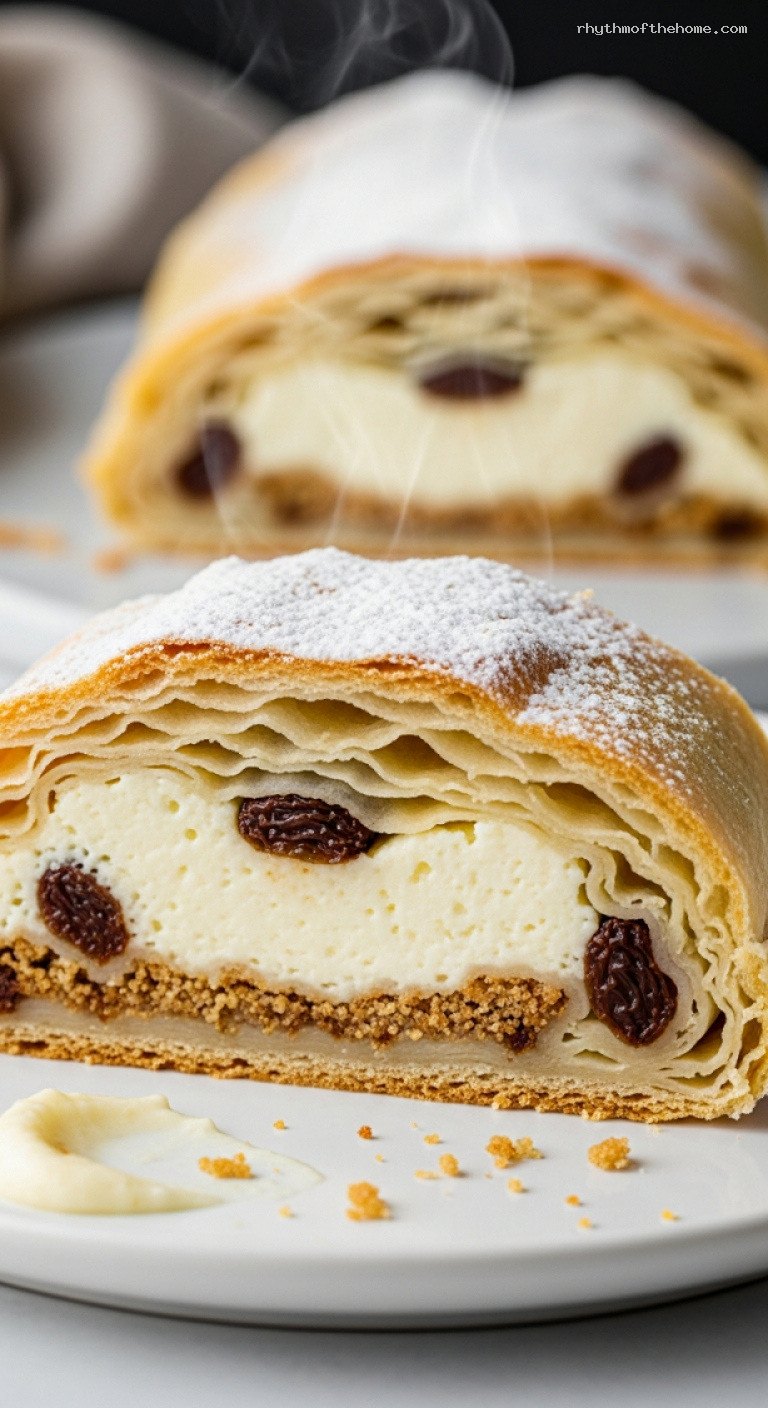
Step-by-Step Instructions
Step 1: Make the strudel dough
In a medium mixing bowl, whisk together the flour and salt. Make a well in the center. In a jug or small bowl, mix the lukewarm water, neutral oil, and vinegar. Pour the liquid into the well.
Use a fork or your fingers to gradually pull flour into the liquid until a shaggy dough forms. Turn the dough out onto a clean work surface and knead for 8–10 minutes. The dough should become smooth, elastic, and slightly tacky but not sticky. If it is very sticky, dust with a teaspoon or two of flour; if it feels dry, wet your hands lightly and continue kneading.
Shape the dough into a smooth ball. Lightly oil the bowl and roll the dough around to coat it with a thin film of oil. Cover tightly with plastic wrap or an upside-down plate and let rest at room temperature for 45 minutes. This resting time relaxes the gluten so the dough can be stretched very thin later.
Step 2: Prepare raisins and toasted breadcrumbs
If using raisins, place them in a small bowl and pour over the rum or warm water. Let soak while the dough rests, stirring once or twice so they plump evenly.
For the breadcrumb layer, melt 30 g (2 tbsp) butter in a small skillet over medium heat. Add the breadcrumbs and cook, stirring constantly, until they turn golden and smell nutty, about 3–5 minutes. Watch closely so they do not burn. Transfer to a plate to cool completely. This crunchy layer will sit under the filling and help absorb excess moisture so the strudel stays crisp.
Step 3: Mix the creamy quark filling
In a large bowl, combine the quark (or well-drained ricotta), granulated sugar, vanilla sugar or extract, sour cream, heavy cream or milk, lemon zest, cornstarch or semolina, and a pinch of salt. Add the egg yolks (reserve the whites in a separate clean bowl). Beat with a hand mixer or vigorous whisking until the mixture is smooth, thick, and no streaks of cornstarch remain.
In the clean bowl, whip the egg whites with a hand mixer on medium-high speed until they form soft peaks that hold their shape but still bend at the tips. Gently fold one-third of the egg whites into the quark mixture to lighten it, then fold in the remaining whites just until no large white streaks remain.
Drain the soaked raisins very well and pat dry with paper towels. Fold them gently into the filling. The finished filling should be creamy and spreadable, not runny. If it feels very loose, you can stir in 1–2 extra tablespoons of cornstarch or semolina.
Step 4: Preheat the oven and prepare your workspace
Preheat the oven to 190°C / 375°F (conventional, not fan). Line a large baking sheet with parchment paper.
Choose a large table or countertop for stretching the dough. Lay down a clean cotton or linen tablecloth or a large kitchen towel and lightly dust it with flour. Have the cooled toasted breadcrumbs, quark filling, melted butter (from the 60 g amount), and prepared baking sheet nearby. This way, once the dough is stretched, you can assemble and roll the strudel quickly before the dough dries out.
Step 5: Stretch the strudel dough paper-thin
Place the rested dough ball on the lightly floured cloth. With a rolling pin, roll it into a rectangle about 30 x 40 cm (12 x 16 inches). Then slip your hands under the dough, backs of your hands facing up, and gently stretch from the center outward using the backs of your hands and knuckles. Let gravity help; move slowly, rotating the dough as you go.
Continue stretching until the dough is very thin and almost translucent—you should be able to read the pattern of the cloth underneath. Aim for a rough rectangle about 60 x 80 cm (24 x 32 inches). If small holes appear, pinch them together or leave them; they will be hidden when the dough is rolled. Trim off the thicker outer edges with a knife or scissors, as they will not bake up as delicately.
Step 6: Fill, roll, and shape the strudel
Brush the entire surface of the stretched dough lightly with melted butter. Sprinkle the toasted breadcrumbs evenly over the lower third of the dough (the long edge closest to you), leaving a 3–4 cm (1 1/2 inch) border on the sides and bottom.
Spoon the quark filling over the breadcrumbs and spread it into an even layer over that same lower third area. Fold the short sides of dough over the filling by about 3–4 cm (1 1/2 inch) to enclose the ends.
Now, using the cloth to help you, gently lift the filled end and roll the dough away from you into a snug log, letting the cloth do most of the work. Try not to tear the dough as you roll. When fully rolled, you will have a long, filled cylinder. Carefully transfer the strudel to the prepared baking sheet, seam-side down. This is easiest by using the cloth to gently nudge and roll it onto the tray. Curve it slightly if needed to fit. Brush the entire surface generously with melted butter.
Step 7: Bake, rest, and serve
Bake the strudel in the preheated oven for 35–40 minutes, or until the crust is a deep golden brown and crisp. Halfway through baking, brush once more with melted butter for extra color and flakiness.
When done, remove the strudel from the oven and let it rest on the tray for at least 15–20 minutes. This allows the filling to set slightly, so the slices hold their shape. Dust generously with powdered sugar while still warm.
To serve, use a sharp serrated knife to cut slices about 3–4 cm (1 1/4–1 1/2 inches) thick. Serve warm or at room temperature, plain or with softly whipped cream or vanilla sauce. The contrast of the crisp, paper-thin pastry and the cool, tangy, creamy filling is what makes Topfenstrudel so special.
Pro Tips
- Warm dough stretches best: If your kitchen is very cool, let the dough rest somewhere slightly warm (but not hot) so it stays supple and easier to stretch thin.
- Do not skip the breadcrumb layer: It acts like a sponge under the filling, preventing a soggy bottom while adding a subtle nutty flavor.
- Drain soft cheeses well: If using ricotta or very moist quark, drain thoroughly to avoid a runny filling. The filling should be thick and scoopable.
- Use the cloth to roll: Trying to roll only with your hands can tear the dough. Let the cloth lift and roll the strudel for you in one smooth motion.
- Let it cool slightly before slicing: Cutting too hot will make the filling ooze. A short rest gives cleaner slices and better texture.
Variations
- Apricot Topfenstrudel: Scatter a layer of well-drained canned or poached apricot halves (patted dry) over the quark filling before rolling. The sweet-tart fruit pairs beautifully with the creamy cheese.
- Berry Swirl Topfenstrudel: Dollop 4–5 tablespoons of thick berry jam (raspberry, red currant, or blueberry) over the quark layer and gently swirl with a spoon before rolling.
- Phyllo Shortcut: Replace the homemade dough with 8–10 sheets of thawed phyllo. Layer the sheets, brushing each with melted butter, add the breadcrumb layer and filling, then roll and bake as directed, reducing the baking time by about 5 minutes if it browns quickly.
Storage & Make-Ahead
Topfenstrudel is best on the day it is baked, when the pastry is crisp and the filling is just set. Leftovers can be cooled completely, then stored in an airtight container in the refrigerator for up to 3 days. Reheat slices in a 160°C / 320°F oven for 10–15 minutes until warmed through and the crust is re-crisped; avoid microwaving if you want to keep the pastry flaky.
To make ahead, you can prepare the dough and let it rest, covered, in the refrigerator for up to 12 hours. Bring it back to room temperature for at least 30 minutes before stretching. The filling can also be mixed (without folding in egg whites) up to 1 day ahead and refrigerated; whip and fold in the egg whites just before assembly. Fully assembled but unbaked strudel does not store well, as the dough can soften and tear, so it is best to bake shortly after filling.
Nutrition (per serving)
Approximate values per serving (1/8 of the strudel): 360–390 calories; 18 g fat; 11 g saturated fat; 35–40 g carbohydrates; 2 g fiber; 17–20 g sugar; 14–16 g protein; 260–320 mg sodium. Values will vary based on the exact cheeses, creams, and optional raisins used.

Leave a Reply