
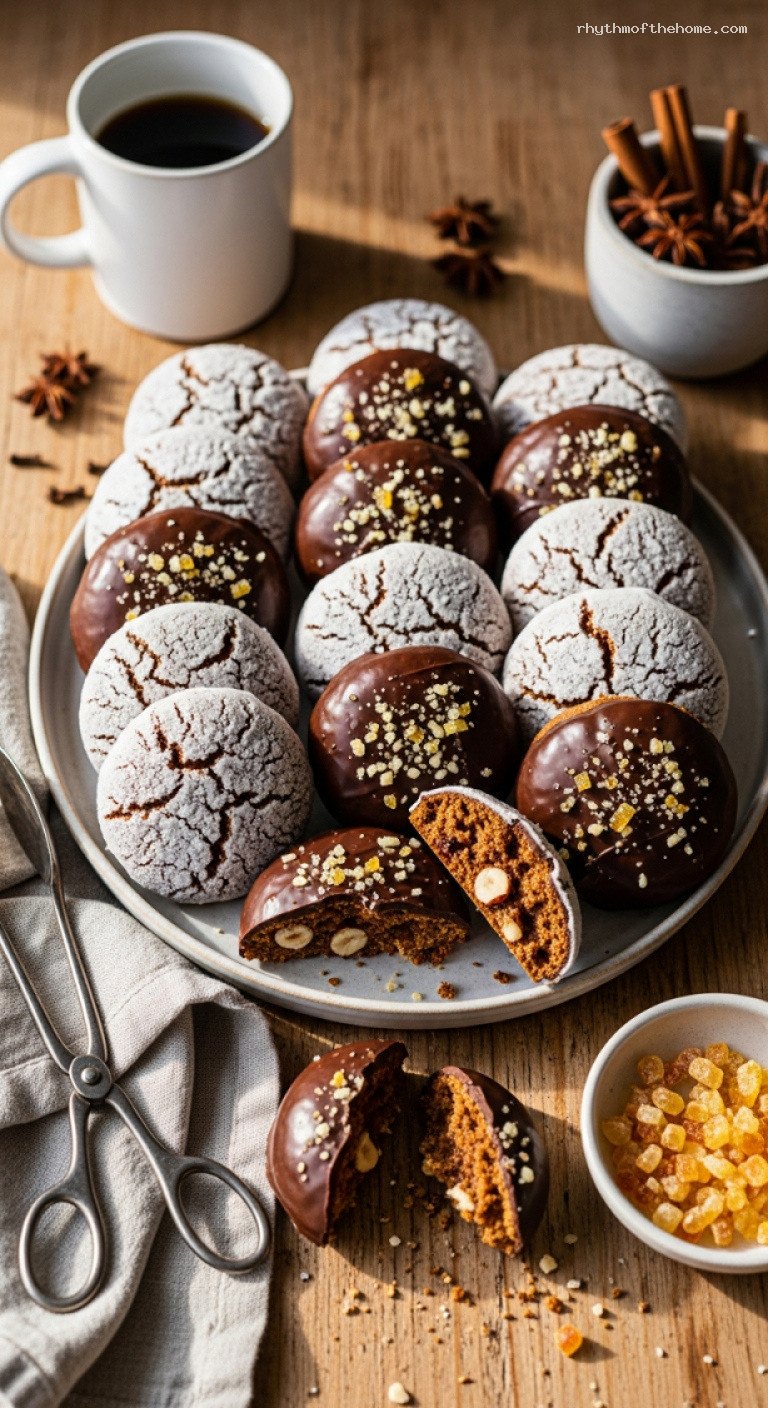
Quick Recipe Version (TL;DR)
Quick Ingredients
- 200 g (2/3 cup) runny honey
- 100 g (1/2 cup) brown sugar, packed
- 50 g (3 1/2 tbsp) unsalted butter
- 1 large egg + 1 large egg yolk
- 250 g (2 cups) all-purpose flour
- 150 g (1 1/2 cups) finely ground almonds
- 50 g (1/2 cup) finely ground hazelnuts or more almonds
- 100 g (2/3 cup) finely chopped candied mixed citrus peel
- 1 tsp baking powder, 1/4 tsp baking soda, pinch salt
- Spices: 2 tsp cinnamon, 1/2 tsp each cloves, allspice, ginger, anise; 1/4 tsp nutmeg; optional 1/4 tsp cardamom
- Finely grated zest of 1 small orange (optional)
- 24 round oblaten wafers, 70 mm (optional)
- 120 g (1 cup) powdered sugar + 2–3 tbsp hot water (sugar glaze)
- 200 g (7 oz) dark chocolate (60–70%) + 1 tsp neutral oil (chocolate glaze, optional)
- 12 whole blanched almonds, halved (for decoration)
Do This
- 1. Gently heat honey, brown sugar, and butter until melted and smooth. Cool to lukewarm, then whisk in egg and egg yolk.
- 2. In a large bowl, combine flour, ground nuts, candied peel, baking powder, baking soda, salt, spices, and orange zest.
- 3. Stir the honey mixture into the dry ingredients to form a thick, sticky batter. Cover and rest 12–24 hours at cool room temperature or in the fridge.
- 4. Next day, preheat oven to 180°C / 350°F. Line trays (and place oblaten if using). Scoop heaped tablespoons of dough onto wafers or directly onto trays, smoothing into 5–6 cm rounds.
- 5. Bake 12–14 minutes until puffed, set, and only lightly golden at the edges. Cool completely on racks.
- 6. For sugar glaze, mix powdered sugar with hot water to a thick but pourable glaze; brush or spoon over warm cookies.
- 7. For chocolate glaze, melt dark chocolate with oil; dip or spoon over cooled cookies. Decorate with almond halves and let set before storing.
Why You’ll Love This Recipe
- Classic German Christmas flavor: deep honey, warm spices, nuts, and candied citrus in every soft bite.
- Texture perfection: somewhere between a cookie and a small cake—tender, slightly chewy, never dry.
- Flexible finishing: choose a glossy sugar glaze, dark chocolate coating, or a mix of both.
- Ideal make-ahead treat: they actually taste better after a few days of resting in the tin.
Grocery List
- Produce: 1 small orange (for zest), 1 lemon (if you want lemony sugar glaze, optional).
- Dairy: Unsalted butter, eggs.
- Pantry: Runny honey, brown sugar, all-purpose flour, ground almonds, ground hazelnuts (or extra almonds), candied mixed citrus peel, baking powder, baking soda, fine salt, ground cinnamon, ground cloves, ground allspice, ground ginger, ground anise or aniseed, ground nutmeg, ground cardamom, powdered sugar, dark chocolate (60–70%), neutral oil (e.g., sunflower), whole blanched almonds, round oblaten wafers (optional).
Full Ingredients
For the Lebkuchen Dough
- 200 g runny honey (about 2/3 cup)
- 100 g light or dark brown sugar, packed (about 1/2 cup)
- 50 g unsalted butter (about 3 1/2 tablespoons), cut into pieces
- 1 large egg
- 1 large egg yolk
- 250 g all-purpose flour (about 2 cups, spooned and leveled)
- 150 g finely ground blanched almonds (about 1 1/2 cups)
- 50 g finely ground hazelnuts or more almonds (about 1/2 cup)
- 100 g finely chopped candied mixed citrus peel (about 2/3 cup, packed)
- 1 teaspoon baking powder
- 1/4 teaspoon baking soda
- 1/4 teaspoon fine sea salt
- 2 teaspoons ground cinnamon
- 1/2 teaspoon ground cloves
- 1/2 teaspoon ground allspice
- 1/2 teaspoon ground ginger
- 1/2 teaspoon ground anise (or finely crushed aniseed)
- 1/4 teaspoon ground nutmeg
- 1/4 teaspoon ground cardamom (optional but traditional)
- Finely grated zest of 1 small untreated orange (optional but recommended)
- 24 round oblaten wafers, about 70 mm / 2 3/4 inches (optional, for the base)
For the Simple Sugar Glaze
- 120 g powdered (confectioners’) sugar, sifted (about 1 cup)
- 2–3 tablespoons very hot water (start with 2, add more by the teaspoon as needed)
- 1/2 teaspoon vanilla extract or 1 teaspoon freshly squeezed lemon juice (optional, for flavor)
For the Chocolate Glaze (Optional)
- 200 g dark chocolate (60–70%), finely chopped (about 7 oz)
- 1 teaspoon neutral oil (such as sunflower or grapeseed) or 10 g cocoa butter
For Decoration (Optional)
- 12 whole blanched almonds, halved lengthwise (24 halves total)
- Extra finely chopped candied citrus peel, for sprinkling
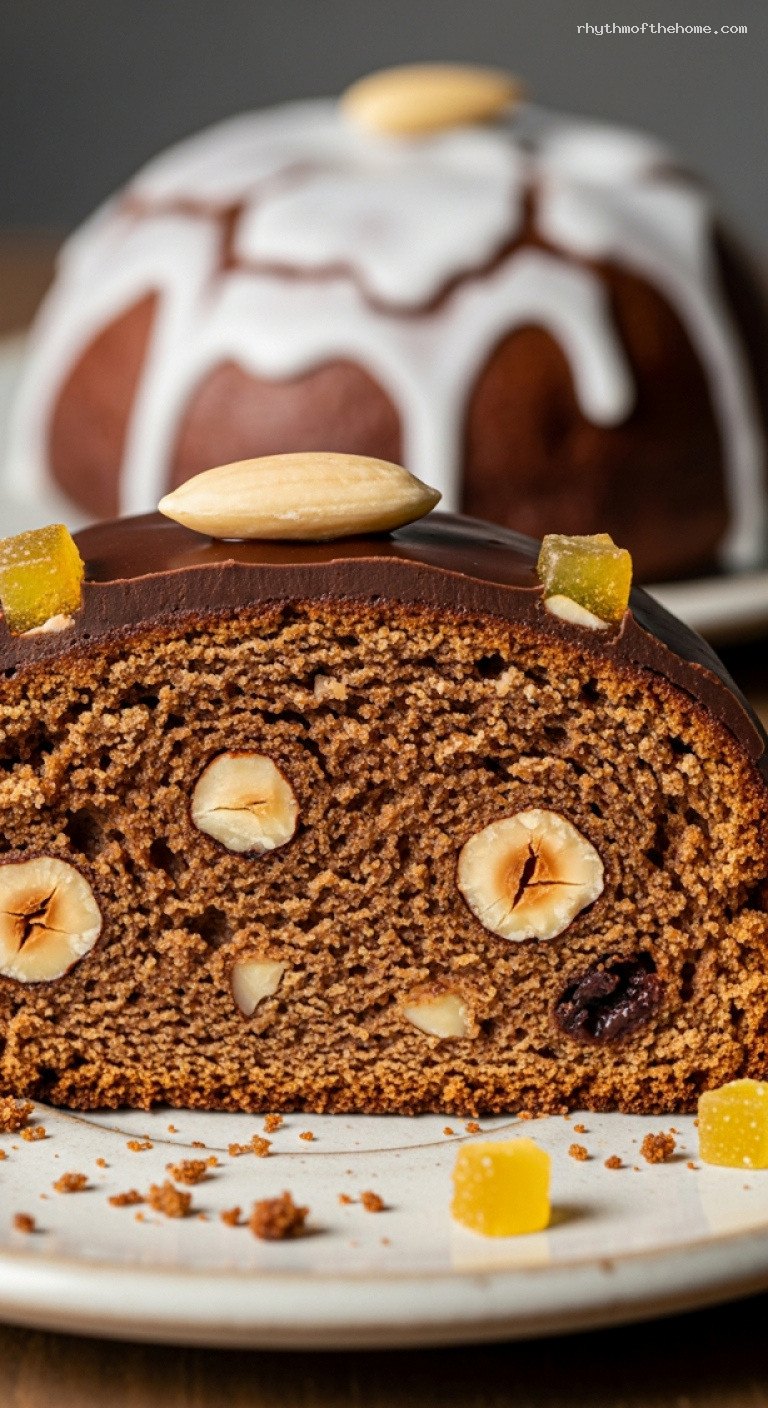
Step-by-Step Instructions
Step 1: Warm the honey, sugar, and butter
Place the honey, brown sugar, and butter in a small saucepan. Set over low to medium-low heat and warm gently, stirring often, until the butter has melted and the mixture is smooth and just beginning to steam. Do not let it boil; you only want it warm enough to dissolve the sugar and blend everything together. Remove the pan from the heat and let the mixture cool until it is lukewarm (about 30–35°C / 86–95°F) so it does not scramble the eggs in the next step. This usually takes 10–15 minutes. Stir occasionally to speed up the cooling.
Step 2: Mix the dry ingredients and flavorings
While the honey mixture cools, prepare the dry ingredients. In a large mixing bowl, whisk together the flour, ground almonds, ground hazelnuts (or additional almonds), baking powder, baking soda, salt, cinnamon, cloves, allspice, ginger, anise, nutmeg, and cardamom (if using). Make sure there are no clumps of baking powder or soda. Stir in the finely chopped candied mixed peel and, if using, the finely grated orange zest. Toss until the peel pieces are well separated and coated in the dry mixture; this helps them distribute evenly in the dough.
Step 3: Combine wet and dry to make a sticky dough
Once the honey mixture is lukewarm, whisk in the egg and egg yolk until fully blended and glossy. Make a well in the dry ingredients and pour in the honey-egg mixture. Using a sturdy wooden spoon or spatula, stir everything together until no dry streaks of flour remain. The mixture will be very thick, shiny, and sticky—almost more like a stiff batter than a conventional cookie dough. Scrape down the sides of the bowl, smoothing the top. Cover the bowl tightly with a lid, plate, or plastic wrap.
Step 4: Rest the dough for 12–24 hours
Let the covered bowl rest for at least 12 hours and up to 24 hours. You can keep it at cool room temperature (if your kitchen is not hot) or in the refrigerator. This resting time is important: the flour fully hydrates, the nuts soften slightly, and the spices bloom, giving you that deep, characteristic Lebkuchen flavor and a soft, cakey texture. If chilled, the dough will firm up; that is normal and actually makes it easier to portion. About 30 minutes before baking, if the dough is very cold and hard, let it sit at room temperature to soften slightly so you can scoop it.
Step 5: Portion and shape the Lebkuchen
Preheat your oven to 180°C / 350°F with a rack in the middle. Line two baking sheets with parchment paper. If you are using oblaten wafers, arrange them on the parchment, leaving at least 2 cm (about 3/4 inch) between each. Using a heaped tablespoon or a small cookie scoop (about 30–35 g dough per cookie), scoop portions of dough onto each wafer or directly onto the parchment. With slightly damp fingers or the back of a damp spoon, gently smooth each mound into a neat round about 5–6 cm (2–2 1/4 inches) in diameter and roughly 1 cm (3/8 inch) thick. The dough will spread only a little in the oven, so aim for the final size you want now.
Step 6: Bake until puffed and just set
Bake one tray at a time for 12–14 minutes, rotating the tray halfway through for even baking. The Lebkuchen should puff slightly and look set on top, with just a hint of light golden color around the edges, but they should not brown deeply—overbaking will make them dry instead of soft. The centers may still look a touch soft; they will firm up as they cool. Remove the baking sheet from the oven and let the Lebkuchen cool on the tray for 5–10 minutes, then transfer them carefully to a wire rack to cool completely. Repeat with the second tray.
Step 7: Glaze with sugar and/or chocolate and decorate
For the sugar glaze, whisk the powdered sugar with 2 tablespoons of very hot water (and vanilla or lemon juice, if using) until smooth and thick but pourable. Add more hot water a teaspoon at a time if needed. While the Lebkuchen are still slightly warm but not hot, brush or spoon the glaze generously over the tops, letting it drip down the sides. It will set to a thin, opaque, slightly crackly coating. For the chocolate glaze, melt the chopped dark chocolate with the oil (or cocoa butter) in a heatproof bowl set over a pan of barely simmering water, or in short bursts in the microwave, stirring often, until smooth and glossy. Let cool slightly until thickened but still fluid. Dip the tops of completely cooled Lebkuchen into the chocolate or spoon the chocolate over them. Place back on the rack and immediately top each with an almond half or a pinch of candied peel, if desired. Let all glazes set completely (30–60 minutes) before packing the Lebkuchen into an airtight tin. They taste best after resting for at least 1 day.
Pro Tips
- Resting is key: Do not skip the overnight rest. It transforms the dough from ordinary spiced cookies into true Lebkuchen with a deep, rounded flavor and soft, cakey texture.
- Do not overbake: Pull the cookies from the oven while they still look pale and just set. If they are deeply browned, they will be too dry once cooled.
- Adjust glaze thickness: For a thin, sheer sugar glaze, use a bit more water; for a thick, opaque coating, keep it quite stiff. You can always add more powdered sugar if it becomes too runny.
- Use good chocolate: A smooth, not overly sweet dark chocolate (60–70%) gives the most authentic flavor and contrasts beautifully with the sweet, spiced interior.
- Let them mature: Like many traditional Christmas cookies, Lebkuchen improve over several days as the flavors meld and the texture becomes even more tender.
Variations
- All-sugar glazed Lebkuchen: Skip the chocolate and glaze all of the cookies with the simple sugar glaze for a more old-fashioned look and a brighter citrus note if you use lemon juice.
- Nutty topping: Before baking, gently press a whole almond, hazelnut, or pecan half into the top of each cookie. You can still glaze them afterward; the nut will peek through.
- Extra-fruity version: Add 50 g (about 1/3 cup) finely chopped dried apricots or raisins along with the candied peel for a more fruitcake-like Lebkuchen.
Storage & Make-Ahead
Once the glazes are fully set, layer the Lebkuchen in an airtight tin or container, separating layers with parchment paper so they do not stick. Store at cool room temperature for up to 2–3 weeks. The flavor actually improves after a few days, and the texture becomes even softer and more tender, so they are perfect to make well ahead of the holidays. For longer storage, you can freeze the glazed or unglazed cookies for up to 3 months; thaw at room temperature in a single layer before stacking or serving. You can also freeze the rested dough tightly wrapped for up to 1 month, then thaw in the refrigerator, bring to a scoopable consistency, and proceed with shaping and baking.
Nutrition (per serving)
Approximate values per Lebkuchen (1 of 24), assuming a mix of sugar and chocolate glazes: about 210 calories; 4 g protein; 10 g fat; 28 g carbohydrates; 1.5 g fiber; 16 g sugars; 70 mg sodium. These numbers are estimates and will vary with the exact size of your cookies and how much glaze you use.

Leave a Reply