
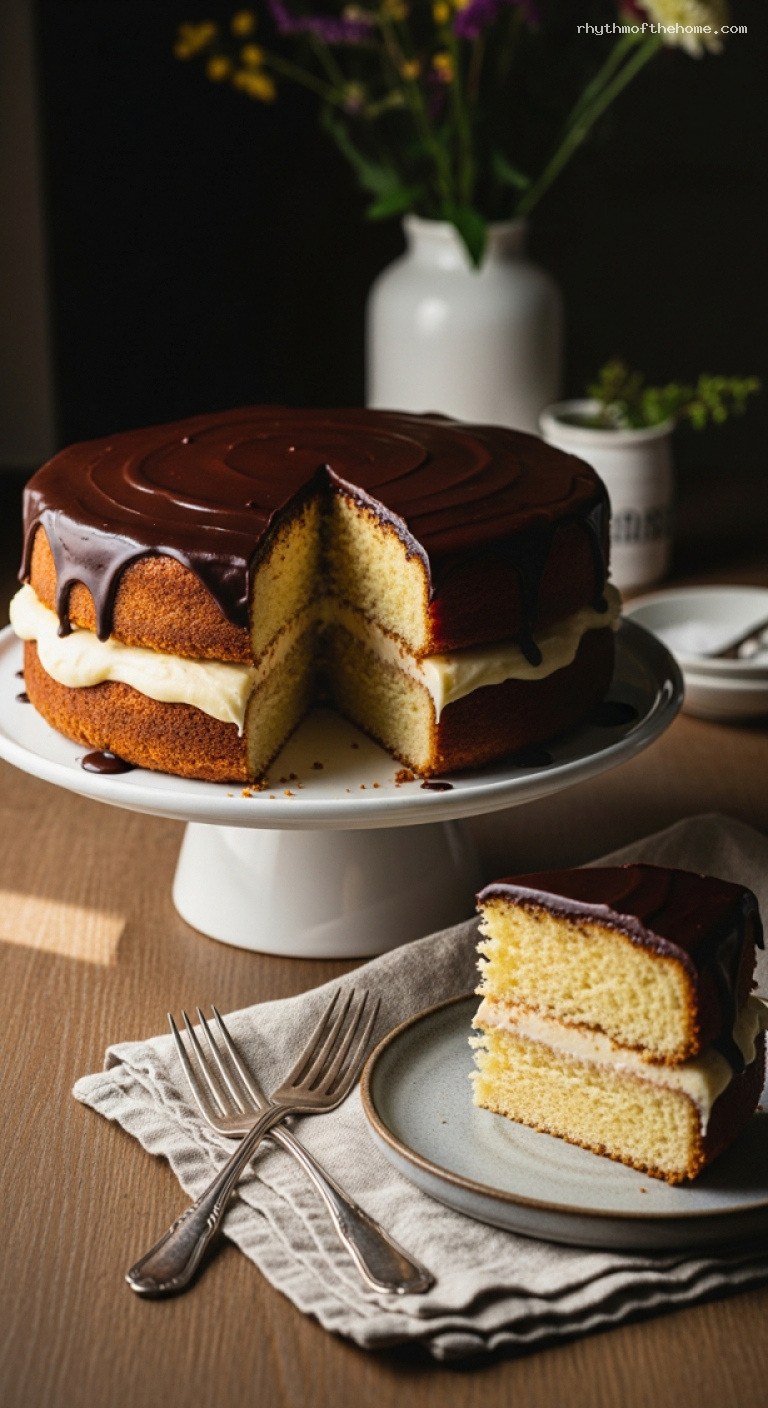
Quick Recipe Version (TL;DR)
Quick Ingredients
- Tender Sponge Cake: 1 1/4 cups (150 g) cake flour; 1 1/2 tsp baking powder; 1/2 tsp fine salt; 4 large eggs, separated; 3/4 cup (150 g) granulated sugar, divided; 1/3 cup (80 ml) whole milk; 1/4 cup (60 ml) neutral oil; 2 tsp vanilla extract; 1/2 tsp cream of tartar or 1 tsp lemon juice.
- Vanilla Pastry Cream: 2 cups (480 ml) whole milk; 1/2 cup (100 g) granulated sugar; 4 large egg yolks; 3 tbsp (24 g) cornstarch; 1/8 tsp fine salt; 1 tbsp (14 g) unsalted butter; 2 tsp vanilla extract.
- Baked-On Chocolate Glaze: 4 oz (115 g) semisweet chocolate, finely chopped; 4 tbsp (56 g) unsalted butter; 1/2 cup (120 ml) heavy cream; 1/3 cup (40 g) powdered sugar, sifted; 1 tbsp (15 ml) light corn syrup; 1 tsp vanilla extract; pinch fine salt.
- Optional Garnish: Fresh berries, shaved chocolate, or a light dusting of powdered sugar around the plate.
Do This
- 1. Make pastry cream: cook milk, yolks, sugar, and cornstarch until thick; stir in butter and vanilla, cover, and chill at least 2 hours.
- 2. Bake sponge: whip yolks with part of the sugar, milk, oil, and vanilla; fold in dry ingredients; whip whites with remaining sugar; fold together and bake in a 9-inch round pan at 350°F (175°C) for 22–26 minutes.
- 3. Cool cake completely, then carefully slice horizontally into two even layers.
- 4. Make glaze: pour hot butter/cream/corn syrup over chopped chocolate, whisk smooth, then blend in powdered sugar, vanilla, and salt until glossy.
- 5. Assemble: place bottom cake layer on a baking sheet, spread chilled pastry cream evenly, and top with second cake layer.
- 6. Spread glaze over top cake layer to the edges and bake at 300°F (150°C) for 8–10 minutes, until glossy and just set; cool, then chill 1 hour before slicing.
Why You’ll Love This Recipe
- A cozy twist on classic Boston cream pie with a shiny, baked-on chocolate glaze that gently sets in the oven.
- Light, tender sponge cake layers that stay moist but sturdy enough to hold a generous layer of silky vanilla pastry cream.
- Make-ahead friendly: each component can be prepared in advance for stress-free entertaining.
- Looks bakery-special but is very doable for home cooks with clear, step-by-step guidance.
Grocery List
- Produce: Optional fresh berries (strawberries, raspberries) and fresh mint for garnish.
- Dairy: Whole milk, heavy cream, unsalted butter, large eggs.
- Pantry: Cake flour (or all-purpose flour), granulated sugar, powdered sugar, cornstarch, baking powder, fine salt, neutral oil (such as canola or vegetable), vanilla extract, semisweet chocolate, light corn syrup, cream of tartar or lemon juice.
Full Ingredients
Tender Sponge Cake Layers
- 1 1/4 cups (150 g) cake flour, spooned and leveled
- 1 1/2 tsp baking powder
- 1/2 tsp fine sea salt
- 4 large eggs, room temperature, separated
- 3/4 cup (150 g) granulated sugar, divided (1/2 cup plus 1/4 cup)
- 1/3 cup (80 ml) whole milk, room temperature
- 1/4 cup (60 ml) neutral oil (such as canola or vegetable)
- 2 tsp pure vanilla extract
- 1/2 tsp cream of tartar or 1 tsp fresh lemon juice (to stabilize egg whites)
Vanilla Pastry Cream Filling
- 2 cups (480 ml) whole milk
- 1/2 cup (100 g) granulated sugar
- 4 large egg yolks
- 3 tbsp (24 g) cornstarch
- 1/8 tsp fine sea salt
- 1 tbsp (14 g) unsalted butter
- 2 tsp pure vanilla extract
Glossy Baked-On Chocolate Glaze
- 4 oz (115 g) semisweet or bittersweet chocolate (60–70% cacao), finely chopped
- 4 tbsp (56 g) unsalted butter, cut into pieces
- 1/2 cup (120 ml) heavy cream
- 1/3 cup (40 g) powdered sugar, sifted
- 1 tbsp (15 ml) light corn syrup (for shine; optional but recommended)
- 1 tsp pure vanilla extract
- Pinch fine sea salt
For Assembly & Serving
- Nonstick baking spray or soft butter, for greasing pan (bottom only)
- Parchment paper, for lining pan
- Optional: fresh berries, shaved chocolate, or mint sprigs for garnish
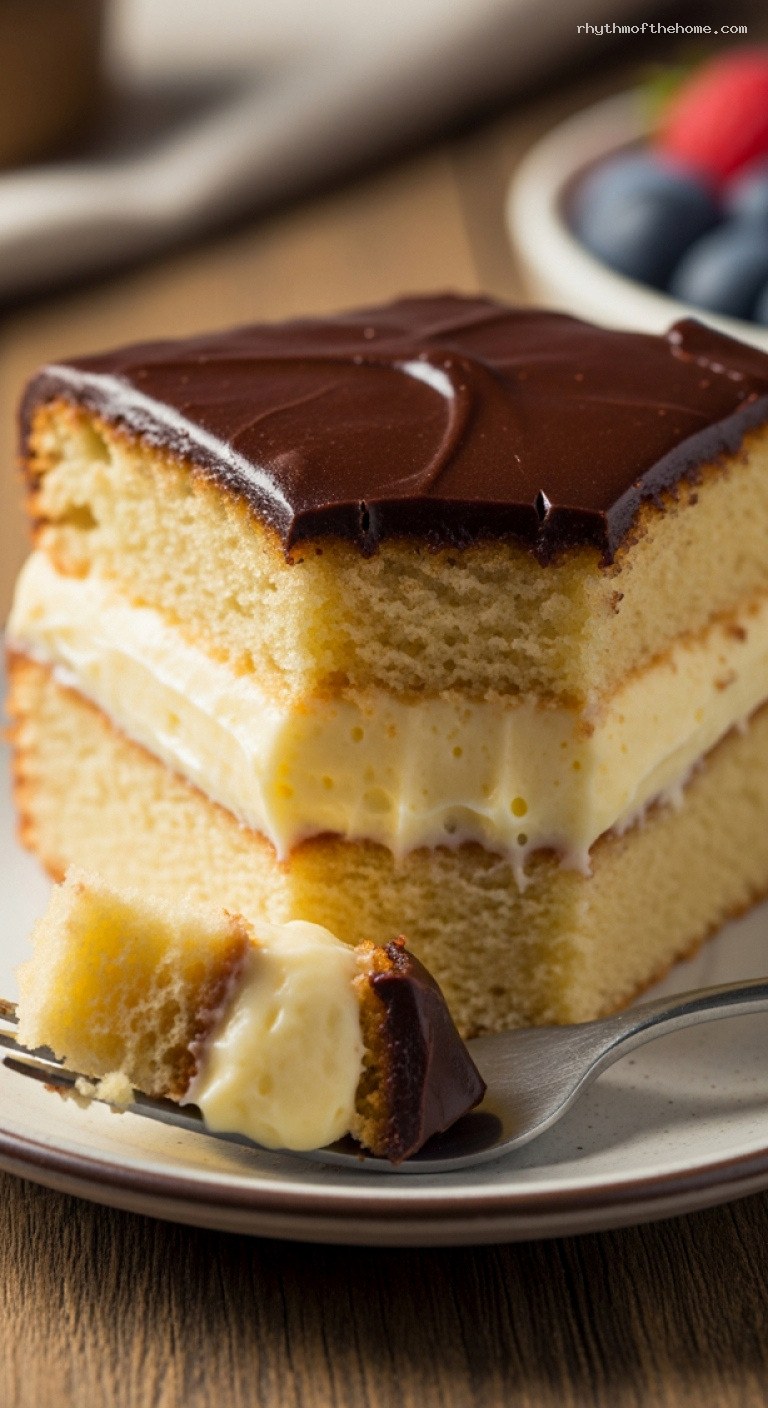
Step-by-Step Instructions
Step 1: Make the vanilla pastry cream
Start with the pastry cream so it has plenty of time to chill and set. In a medium bowl, whisk together the egg yolks, granulated sugar, cornstarch, and salt until very smooth and slightly lightened in color. The mixture should look thick and glossy with no lumps of cornstarch.
In a medium saucepan, heat the milk over medium heat until it is steaming and just beginning to bubble around the edges, but not boiling. While whisking the yolk mixture constantly, slowly pour in about half of the hot milk to temper the eggs. Whisk well, then pour everything back into the saucepan with the remaining milk.
Place the pan over medium heat and cook, whisking constantly, until the mixture thickens and starts to bubble. Once it bubbles, continue cooking and whisking for 1 full minute to cook out the starch taste. Remove from heat and whisk in the butter and vanilla until smooth.
Immediately pour the pastry cream through a fine-mesh sieve into a clean bowl to catch any bits of cooked egg. Press plastic wrap directly onto the surface to prevent a skin from forming. Chill in the refrigerator until completely cold and firm, at least 2 hours (and up to 2 days).
Step 2: Preheat the oven and prepare the cake pan
When the pastry cream is chilling, prepare the cake. Preheat your oven to 350°F (175°C) with a rack in the center. Lightly grease the bottom (but not the sides) of a 9-inch (23 cm) round cake pan that is at least 2 inches (5 cm) deep. Line the bottom with a round of parchment paper and lightly grease the parchment as well.
Leaving the sides of the pan ungreased helps the sponge cake climb and rise evenly, giving you a taller, more tender layer that is easier to split in half later.
Step 3: Make the tender sponge cake batter
In a medium bowl, whisk together the cake flour, baking powder, and salt. Set aside. In a large mixing bowl, whisk the egg yolks and 1/2 cup (100 g) of the granulated sugar until the mixture is thick, pale, and ribbons off the whisk, 2–3 minutes by hand or 1–2 minutes with an electric mixer on medium.
Whisk in the milk, oil, and vanilla until smooth and well combined. Sift the flour mixture over the yolk mixture and gently whisk or fold just until no dry streaks remain. Do not overmix.
In a separate clean, dry bowl, beat the egg whites and cream of tartar (or lemon juice) with an electric mixer on medium speed until foamy. Gradually sprinkle in the remaining 1/4 cup (50 g) sugar and continue beating until medium-soft peaks form – the peaks should hold their shape but gently curl over at the tips.
Using a spatula, fold one-third of the whipped whites into the yolk batter to lighten it. Then gently fold in the remaining whites in two more additions, using broad, sweeping motions and rotating the bowl. Stop as soon as the batter is evenly mixed and airy.
Step 4: Bake and cool the sponge cake
Pour the batter into the prepared pan and smooth the top with a spatula. Gently tap the pan once on the counter to release any large air bubbles. Bake at 350°F (175°C) for 22–26 minutes, or until the top is golden, the cake springs back when lightly touched in the center, and a toothpick inserted into the middle comes out clean or with a few moist crumbs.
Let the cake cool in the pan on a wire rack for 10 minutes. Then run a thin knife around the edge to loosen it. Invert the cake onto the rack, peel off the parchment, and let it cool completely, top side up, about 45–60 minutes. The cake must be fully cool before you slice and fill it, or the pastry cream will soften and ooze.
Once cool, use a long serrated knife to carefully slice the cake horizontally into two even layers. Take your time and rotate the cake as you cut to keep the layers even. Set the top layer aside, cut-side up, and place the bottom layer on a parchment-lined baking sheet or oven-safe serving board.
Step 5: Make the glossy chocolate glaze
While the cake cools, prepare the chocolate glaze. Place the finely chopped chocolate in a heatproof bowl. In a small saucepan, combine the butter, heavy cream, and light corn syrup. Heat over medium until the mixture is steaming and just beginning to simmer around the edges; do not let it fully boil.
Pour the hot cream mixture over the chopped chocolate. Let it stand for 2 minutes to gently melt the chocolate, then whisk until completely smooth and shiny. Sift in the powdered sugar and add the vanilla and a pinch of salt. Whisk again until the glaze is glossy and pourable but not too thin. If it seems very runny, let it sit for 5–10 minutes to thicken slightly before using.
If the glaze cools too much and becomes thick, you can warm it briefly over a double boiler or in the microwave in 5–10 second bursts, stirring constantly, until it returns to a spreadable consistency.
Step 6: Fill and assemble the cake
Give the chilled pastry cream a good stir to smooth it out. If it looks very stiff, whisk briefly by hand until creamy. Spread all of the pastry cream evenly over the cut side of the bottom cake layer, leaving a tiny 1/4-inch (6 mm) border around the edge to allow for gentle spreading when the top layer is added.
Carefully place the top cake layer over the pastry cream, cut side down, lining up the edges. Press very gently with your palms to level the cake and help the cream spread to the edges without squeezing out.
Transfer the assembled cake (on its baking sheet or oven-safe board) to the refrigerator for 15–20 minutes to help the layers and filling firm up slightly. Meanwhile, preheat the oven to 300°F (150°C) for the baked-on glaze step.
Step 7: Bake on the chocolate glaze, cool, and chill
Once the oven is at 300°F (150°C), remove the cake from the fridge. Pour the chocolate glaze onto the center of the top layer and use an offset spatula or the back of a spoon to coax it to the edges, letting a little drip naturally down the sides if you like. Aim for an even, fairly thick coating on top.
Place the cake (still on the baking sheet) in the oven and bake for 8–10 minutes, just until the glaze looks very glossy, fluid, and slightly puffed at the edges. It should not crust over or bubble vigorously; if you see it starting to boil, remove it immediately. This gentle bake helps the glaze settle into a smooth, shiny, “baked-on” finish without overcooking the pastry cream inside.
Remove the cake from the oven and cool at room temperature for about 30 minutes. Then refrigerate, uncovered, for at least 1 hour (or up to overnight) to fully set the filling and glaze. Slice with a sharp, warm knife (dip in hot water and wipe dry between cuts) for the cleanest layers.
Pro Tips
- Chill time matters: The pastry cream needs to be fully cold and thick before you assemble; if it is even slightly warm, it will be too runny and the layers may slide.
- Keep the sponge airy: When folding in the whipped egg whites, use gentle, sweeping motions and stop as soon as the streaks disappear. Overmixing will deflate the batter and make the cake dense.
- Even layers without stress: Lightly score the cake around the sides with your serrated knife at the halfway height, then cut along that guideline, turning the cake as you go. This helps you slice it evenly.
- Watch the final bake closely: The chocolate glaze only needs a short time in the oven. Stay nearby and pull it as soon as it looks glossy and settled; overbaking can dull the shine and dry the cake edges.
- Neat slices: For picture-perfect layers, chill the assembled cake well and use a long, sharp knife warmed in hot water, wiping clean between each slice.
Variations
- Mocha Boston Cream: Add 1–2 tsp instant espresso powder to the hot cream for the glaze and 1 tsp to the pastry cream for a gentle coffee note that pairs beautifully with the chocolate.
- Citrus Twist: Add 1 tsp finely grated orange or lemon zest to the sponge cake batter along with the vanilla, and stir another 1/2 tsp zest into the finished pastry cream for a bright, fresh flavor.
- Extra-Chocolatey Filling: Fold 2–3 tbsp finely chopped dark chocolate into the warm pastry cream and stir until melted, for a subtle chocolate custard sandwiched beneath the glossy glaze.
Storage & Make-Ahead
Store the baked Boston cream pie tightly covered in the refrigerator for up to 3 days. For best texture, let slices sit at room temperature for about 15–20 minutes before serving so the cake softens slightly and the flavors bloom.
To work ahead, you can prepare the pastry cream up to 2 days in advance and keep it chilled with plastic wrap pressed directly onto the surface. The sponge cake can be baked a day ahead, cooled completely, wrapped well in plastic, and kept at room temperature. Assemble with the cream and glaze the cake on the day you plan to serve, then complete the short baked-glaze step and chill until set. Freezing is not recommended, as the pastry cream and glaze can weep and change texture once thawed.
Nutrition (per serving)
Approximate values per serving (1/12 of the cake): about 520 calories; 36 g fat; 22 g saturated fat; 45 g carbohydrates; 31 g sugars; 7 g protein; 1 g fiber; 260 mg sodium. These numbers are estimates and will vary based on specific brands and portion sizes.

Leave a Reply